
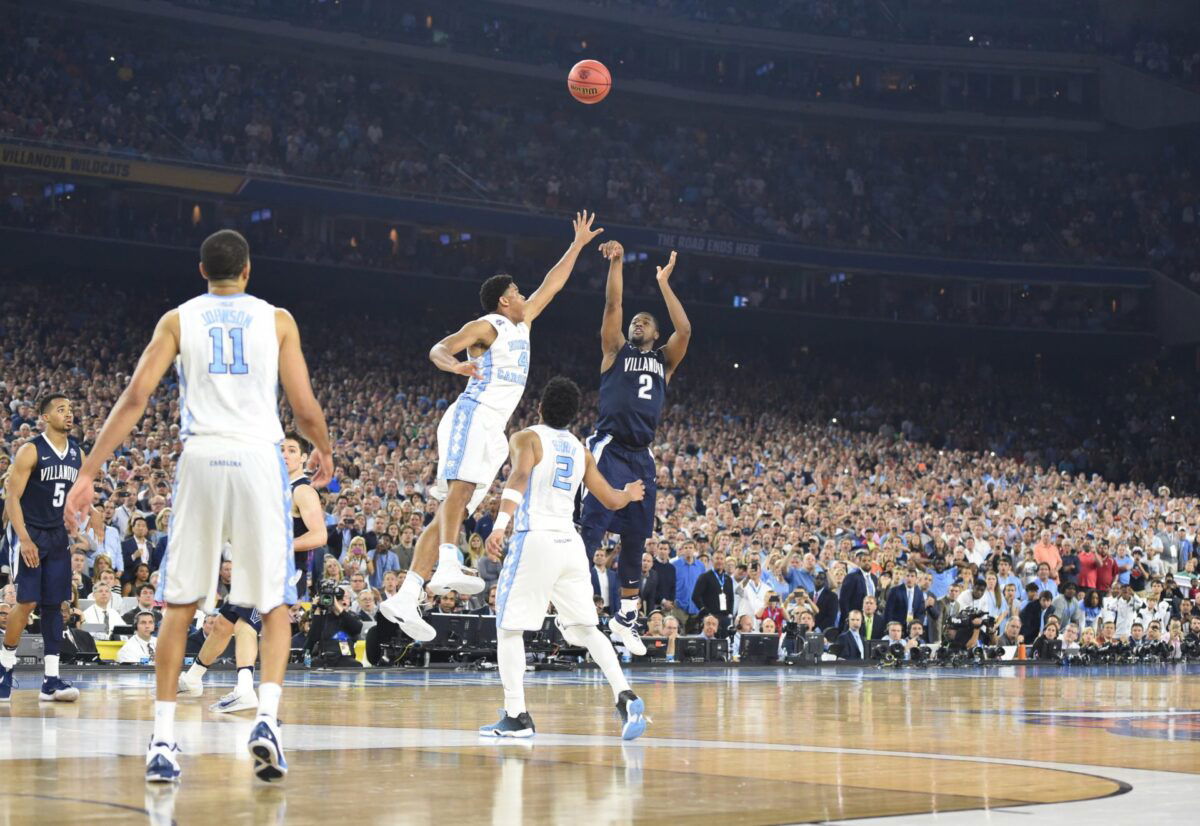
In April 2025, Kris Jenkins, who scored a buzzer-beater to win the 2016 NCAA men’s basketball championship for Villanova, sued the NCAA and major athletic conferences. The allegation was that they illegally hampered him in monetizing his name, image, and likeness (NIL) while playing under NCAA amateurism rules. The court case has finally reached a decision; unfortunately for Jenkins, it’s not in his favour.
Watch What’s Trending Now!
Filed in the U.S. District Court for the Southern District of New York, Jenkins’ complaint stretched 127 pages. It was brought by attorney Kevin Thomas Duffy, Jr., who asserted claims under federal antitrust law and related equitable theories. The defendants included the NCAA, the ACC, the Big Ten, the SEC, the Pac-12, and the Big East. Jenkins argued that these entities conspired to enforce eligibility restrictions that constituted a group boycott and unreasonable restraint of trade, thereby violating Section 1 of the Sherman Act.
However, a federal judge in New York ruled Monday to dismiss the antitrust suit. Judge Denise Cote of the U.S. District Court for the Southern District of New York said that Jenkins’s suit was brought too late and is locked by the 2017 Alston v. NCAA class action settlement. “It is undisputed that Jenkins was a member of the Alston class and did not opt out of that litigation,” Cote wrote. (via the Inquirer)
ADVERTISEMENT
The 2017 Alston settlement was a $208 million antitrust class action resolution over the NCAA’s old cap on athletic scholarships (grant‑in‑aid), separate from the later Supreme Court case NCAA v. Alston that focused on education‑related benefits. Jenkins refused to comment, according to the Inquirer, but his attorney, Kevin T. Duffy Jr., said they planned to appeal but declined to comment further.
During Jenkins’ collegiate career at Villanova (from 2013–2017), he was prohibited from engaging in NIL activity according to the NCAA rules at the time. Even though Jenkins qualified as a class member in the presented House v. NCAA settlement, covering Division I athletes from June 15, 2016, onward, he opted out to preserve his individual claims. However, he did take his cut from the 2017 NCAA vs Alston case in which he was a part of the class.
USA Today via Reuters
Mandatory Credits: Bob Donnan-USA TODAY Sports
According to the Inquirer, “Jenkins argued that his claims were not barred because he challenged some rules not raised in the Alston case, but his suit relied on ‘facts that post-date Alston,” Cote wrote, such as when the NCAA in 2021 suspended its bylaw that prohibited athletes from receiving payments for their name, image, and likeness.” Since he cannot re-litigate on the same underpayment theory. In addition, the statute of limitations has already passed on his claims, according to the ruling. (4 years)
ADVERTISEMENT
The House v. NCAA settlement is the 10‑year, roughly $2.8 billion antitrust deal that both pays back Division I athletes for past NIL restrictions, but Jenkins opted out of this to pursue his own claims. His claims stem from the fact that his game-winner, which won Villanova the title, benefited the program and the NCAA financially.
ADVERTISEMENT
Just How Much Is Kris Jenkins “The Shot” Worth?
Villanova vs North Carolina in the 2016 Finals was pure cinema. A crowd of 74,340 people, both screaming and holding their breath at the same time, the Wildcats had one final possession with 4.7 seconds left. The scoreboard was tied 74-74. Ryan Arcidiacono received the ball from the inbound. He heard one distinctive voice — Kris Jenkins screaming at him. “I just heard Kris yelling, ‘Arch, Arch, I’m open,'” Arcidiacono said.
The guard handed the ball to Kris Jenkins, nearly at half-court. However, he caught the ball in stride, squared his feet, and let the 3-pointer go. Time paused in the entire country, as fans gasped. The shot was good as confetti filled the air in no time, winning Villanova its first National Championship since 1985.
ADVERTISEMENT
As a result of that shot, the lawsuit stated, the NCAA reportedly paid the Big East $19.1 million to distribute among its member schools; the athletic department received a $22.6 million gift, the largest in program history; and the athletic program generated $11.4 million in revenue and fully funded its non-revenue sports.
Top Stories
“RIP”: Prayers Pour In as Tom Brady’s Raiders Struck by Tragedy
Footage Surfaces of Florida Police Arresting NASCAR Veteran Over Disturbing Public Misbehavior

“Rest in Peace”: Prayers Pour In From Dan Marino as Dolphins Legend Mourns Tragedy in South Florida Football
Caitlin Clark Shows Concerning Signs vs. Kelsey Plum During USA Camp Debut, per National Reporter
“NFL Was Crying”: Maxx Crosby Says League Forced Him to Remove Shoes Honoring His Daughter
Chiefs QB Patrick Mahomes Loses Faith in Kansas City With Cowboys Decision as FOX Host Calls Out Clark Hunt’s Ownership
The lawsuit alleged that alumni donations Jenkins’ed 27% in 2016. In addition, the enrollment increased. The publicity value of winning the title was about $250 million. It increased to about $1 billion if the value of the game broadcasts was factored in. The NCAA and the various conferences used Jenkins’ face in various promotions and merchandise. All without compensating him for it, according to Jenkins.
“You want your respect as a man, as a human being,” Jenkins told The Inquirer in April. “Obviously, all the other stuff that comes with it. More importantly, to just continue to fight for what’s right.” However, as of now, he will not get a further cut from that money. The court has dismissed his case, unless an appeal leads to a different result.
ADVERTISEMENT
ADVERTISEMENT
ADVERTISEMENT
ADVERTISEMENT
