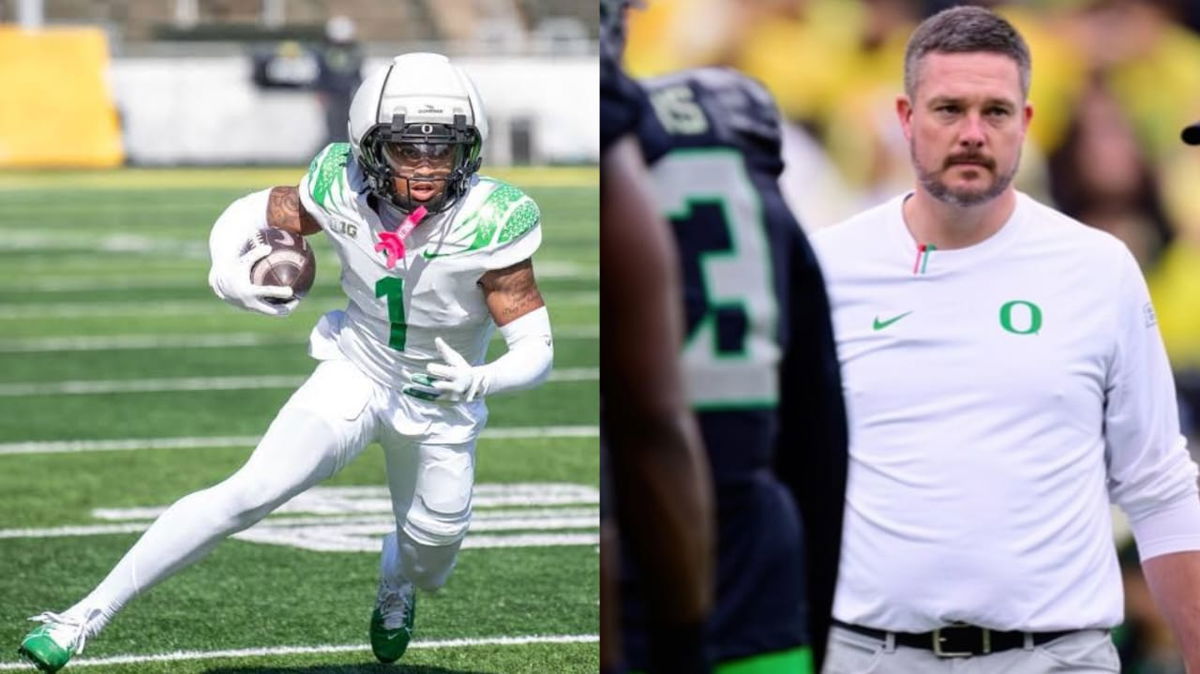
December football strips teams to essentials, and for No. 5 Oregon, availability is the storyline that matters. Dan Lanning’s Ducks open the College Football Playoff at Autzen Stadium on Dec. 20 against James Madison with a thin receiver room. Dakorien Moore has been absent for a month, and his availability shapes how much stress Oregon can place on a defense that will test their personnel decisions. The answers begin with the injury report.


“Oregon Ducks’ first official CFP availability report for Round 1,” Oregon beat reporter Zachary Neel shared on X on December 17.
Watch What’s Trending Now!
Three receivers, including Dakorien Moore (knee), Evan Stewart (right knee), and Gary Bryant Jr. (ankle), are all listed as questionable, along with defensive backs Sione Laulea and Trey McNutt. That designation keeps Oregon’s most explosive options in play and forces JMU to prepare for multiple offensive looks.
Dakorien Moore’s name sits at the center of that uncertainty. The 5-star freshman has been sidelined since late October after a non-contact knee injury in practice ahead of the Iowa game. He last suited up against Wisconsin. His potential return carries weight. Before the injury, Moore produced 28 catches for 443 yards and three touchdowns in eight games. Oregon has survived without him, but the offense has not been whole, and that reality becomes sharper in playoff football.
Oregon Ducks’ first official CFP availability report for Round 1.
As expected, the trio of WRs are all listed as questionable. Also notable that S Trey McNutt is listed as questionable. pic.twitter.com/h6oJa8r8AG
— Zachary Neel (@zacharycneel) December 18, 2025
Gary Bryant’s absence has been just as limiting, though quieter. He has not played since suffering an ankle injury at Iowa. He finished the regular season with 25 receptions for 299 yards and four touchdowns, plus 13 punt returns for 99 yards. On Monday, both receivers fielded punts during open practice periods. Evan Stewart, who has been out all season, was limited and did not take reps early.
For the past three games, Oregon has dressed only four healthy scholarship receivers, briefly down to three against USC. The Ducks adjusted by necessity, leaning on Malik Benson, Jeremiah McClellan, and TE Kenyon Sadiq. They responded as production followed, but what did not return was flexibility, which is a leverage in playoff football.
That leverage grows against a defense like James Madison’s. The Dukes rank inside the top 10 nationally and force opponents to earn space. Dakorien Moore’s vertical presence and Bryant’s return ability stretch coverage and dictate personnel. Without them, Oregon cannot function. With them, they can dictate. That distinction explains why availability carries weight beyond a depth chart, and QB Dante Moore did not hide the preference.
“If we were to have all our weapons back and everybody being ready for this game, next game or whatever it is, it would be for sure a great feeling,” he said. “We’d love to have the clip fully loaded.”
Dan Lanning stopped short of promises but acknowledged momentum. On the Zach Gelb Show, he offered cautious optimism.
“Those guys are making great progress,” he said. “I feel like there’s gonna be an opportunity for us to see these guys again before the season’s done. But we’ll see how it all plays out.”
Imago
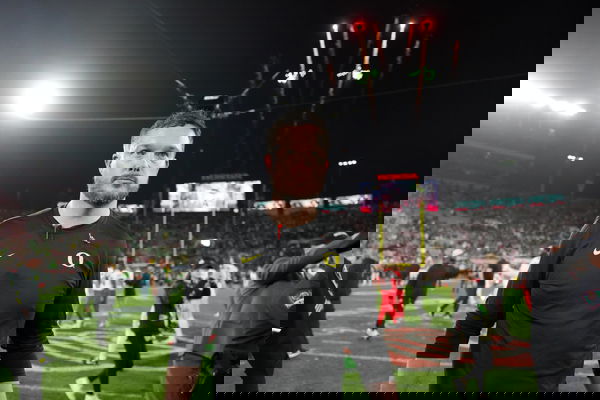
Dan Lanning’s Oregon faces off against Indiana on Saturday for an all-out B1G showdown
All three receivers practiced this week. And while that does not guarantee snaps, it guarantees uncertainty that favors the Ducks. That uncertainty also frames the larger context of this matchup.
Talent gap sets the stage for Oregon vs. JMU
There is a straightforward reason Oregon is favored by 21 points over No. 12 James Madison. Talent accumulation. The Ducks’ roster construction under Dan Lanning reflects a sustained investment in recruiting and the transfer portal. JMU reflects survival and adaptation after a rapid transition. The Dukes were an FCS program five years ago and lost coach Curt Cignetti to Indiana in 2023. Bob Chesney responded by adding more than 100 players across two seasons to stabilize a conference champion.
“We had to find the right guys that fit what we were trying to build,” Chesney said. “And also staying true to the culture that existed here.”
The numbers illustrate the gap. Oregon, now 11-1 and in the Big Ten, signed 85 4-star recruits and five 5-stars across four recruiting cycles. Its last three classes ranked No. 9, No. 4, and No. 3 nationally. James Madison, 12-1, signed 31 3-stars and zero blue-chip recruits over the same span. Its classes ranked 149th, 113th, and 103rd.
That gap does not guarantee outcomes, but it defines ceilings. Oregon RB Noah Whittington respects the warning signs.
“Doubting a lower-level team is the biggest mistake you can ever make,” he said. “But we’re Oregon. We got to be realists about who we are.”
On Friday night, realism begins with availability, and Dakorien Moore remains the player to watch.
Written by

Edited by

Deepali Verma