Imago
Credits:Instagram/@Florence Brunelle
Imago
Credits:Instagram/@Florence Brunelle
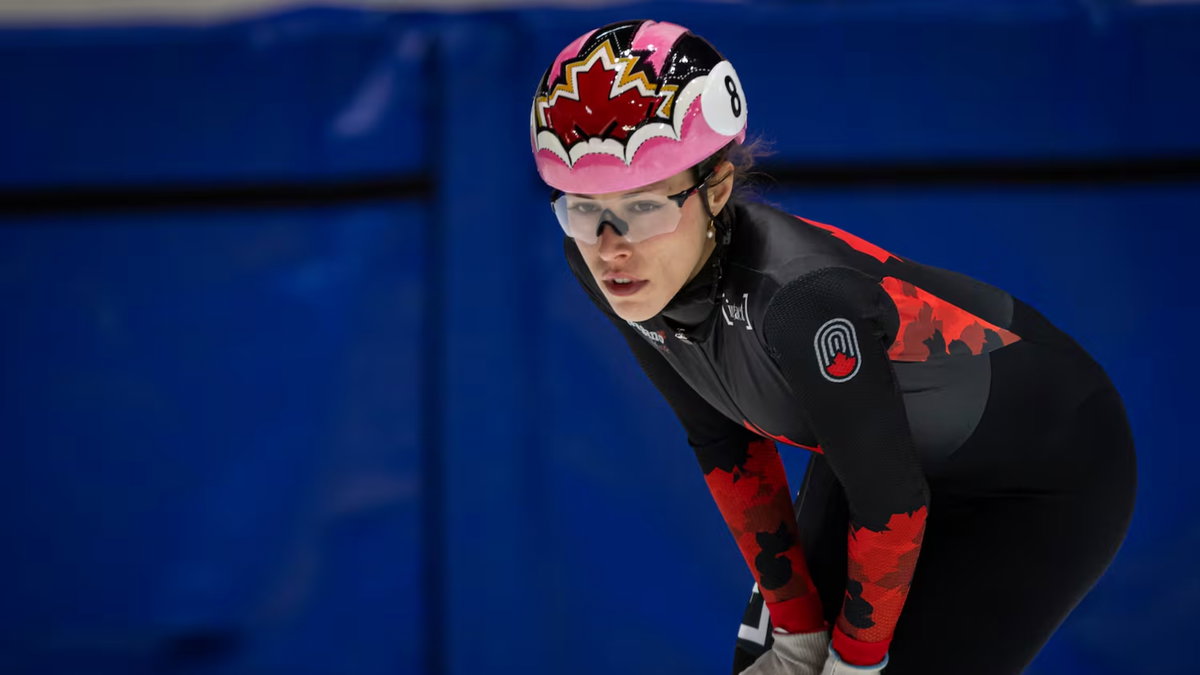
22‑year‑old Canadian Florence Brunelle emerged as one of the breakout stars of the 2026 Winter Olympics after winning two medals on the short track. But it was not just her performance that commanded attention. It was the quiet power of the moment she stepped onto the podium following her silver in the mixed 2000‑metre relay and proudly raised her left hand, the one with only a thumb and pinky, into the air. Dubbed her “Lego hand” by fans, the gesture radiated confidence, turning a difference many might have hidden into a public statement of strength. What she shared later, though, revealed how long it had taken her to arrive at that point.
Watch What’s Trending Now!
Born with a congenital condition, Brunelle has only two fingers on her left hand, something she has linked to a complication during pregnancy. For years, that difference was not easy to accept.
“I used to be ashamed. I used to hide it. I used to wish I wasn’t any different than anyone else,” Florence Brunelle told CBC Olympics.
Top Stories






Brunelle first stepped onto the ice at just seven years old. At the same time, she played high‑level soccer and competed for Quebec at the provincial level. In 2018, she decided to fully commit to speed skating. The sport posed its own challenges, especially in relay exchanges, which rely on grip, timing, and control. She overcame that by using a modified glove to improve her hold.
From there, her progress was steady. Soon after, Florence became a double world champion and a four‑time world junior champion. By the time the 2026 Winter Olympics arrived, she was ready. In Milano–Cortina, she won silver in the mixed relay and bronze in the women’s relay. For her, the moment on the podium meant far more than the medals.
“I used to be ashamed of it. I used to hide it. Until the day I realized how much of a strength it was” 🫶
Canadian speed skater Florence Brunelle, who was born with just two fingers on her left hand, talks about the importance of visibility as an Olympian 🇨🇦 pic.twitter.com/rDFo2jYXzJ
— CBC Olympics (@CBCOlympics) April 8, 2026
“When I get my medals, I’m going to show it, if it can inspire anyone. Yay! Double win! Being out there on the podium, both times I went with my hand and the feedback came too, like the amount of person that texted me to say like, oh, I’m different too. And seeing that really, really made me smile.”
Well, conditions like hers are uncommon, with about 2 in every 1,000 babies born with a congenital hand difference, according to research from the Cleveland Clinic in 2023. Hearing from people who felt seen because of her made the moment even more meaningful.
Florence Brunelle could have treated her condition as a setback, but instead she began to see it as something different. Growing up as the daughter of Jean‑François Brunelle, a hockey player and winner of the 1996 Memorial Cup, may have helped her view her difference as just another part of who she was.
She “realized how much of a strength it was, but also how much I could inspire other people. I think one thing at the Games that I was really, really proud of myself is being able to take that kind of…maybe a bit of responsibility for everyone that feels different in this world to be like, ‘Hey, I’m different too, but it’s actually extremely cool and you should, like that’s a flex’.”
For Florence Brunelle, a multi‑time world junior medallist who had rarely tasted failure on her way to the top of her sport, her story soon reached well beyond racing and medals. Even earning praises from parents:
“The amount of parents that texted me because their young daughter is like that or a girl or a boy, and seeing you being able to accomplish things with that made us feel really like less scared about what’s going to be, because kids are kids, and it’s part of the process to like point out differences in people…”
But for Brunelle, her physical difference was only one part of the journey as the real struggles came later.
The years that tested Florence Brunelle the most
Brunelle had faced many setbacks early in her career. In 2019, she underwent a knee operation. Then came the 2022 Beijing Olympics, where at 18, she became the youngest Canadian short track speed skater ever. It was meant to be her big breakthrough, but it turned into one of the toughest phases of her career.
In the 500 metres, her strongest race, she crashed. In the 3000 metre relay, Canada finished fourth after being overtaken late in the race. For someone used to winning at the junior level, it was a shock. The impact went beyond results.
“I’ve accomplished my dream, and I feel unhappy, so why would I pursue what I’m pursuing? I lost my purpose,” she said. She believed “things were going really fast.”
“I knew I loved sports, I knew I loved being an athlete, but then I was still a teenager, and I wasn’t sure if it was really my choice to do all of this,” she added. “If I sit down and I’m like, what do I want to do with my life, is that the answer?”
Florence then took a break from sports to cope with the trauma of the 2022 Olympics. When she returned, in February 2024, she suffered a back injury that forced her to miss a World Cup event in Dresden. Then, in the summer of 2025, she had to step away from training again because of a herniated disc in her lower back.
She spent the next couple of years on a quiet personal journey to understand herself. She met weekly with a psychologist, calling it a two‑year class on learning how to manage her emotions and handle the pressure of elite sport.
It became a period filled with injuries, uncertainty, and moments where continuing was not an easy choice. And that is what makes the version of Florence Brunelle seen in 2026 so powerful.