Imago
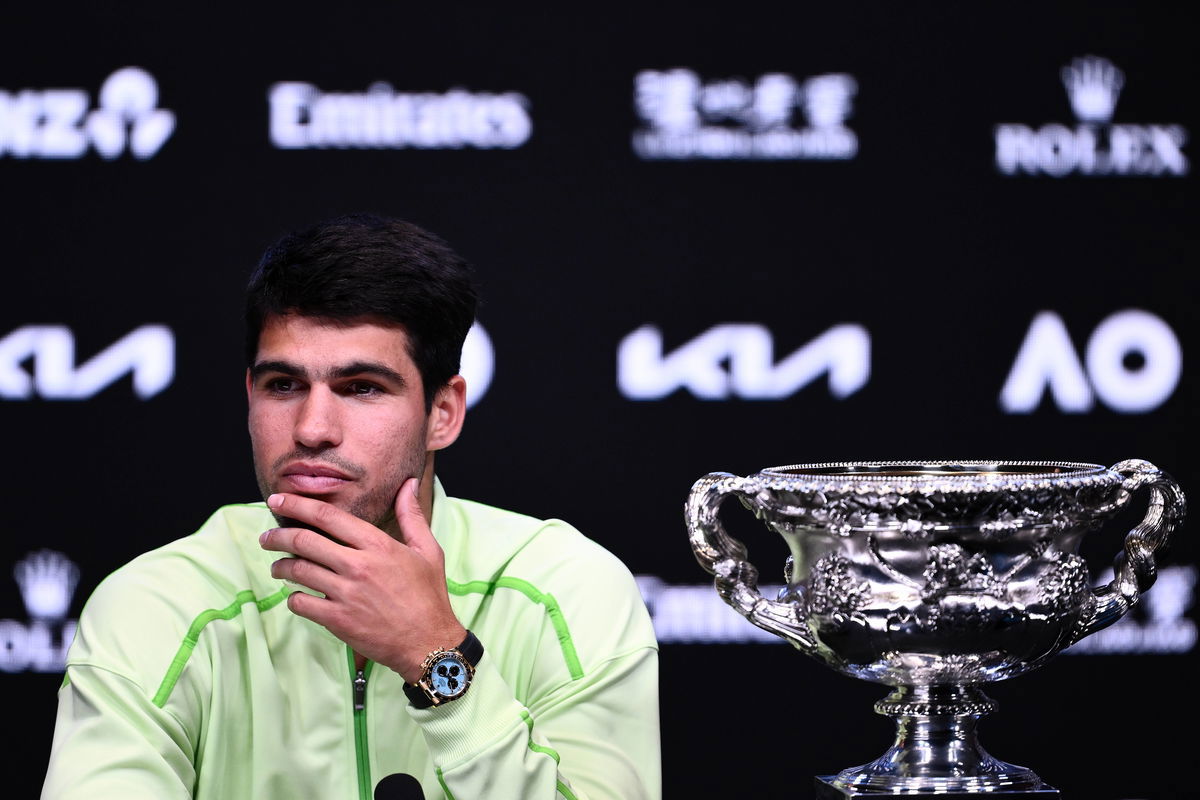
TENNIS AUSTRALIAN OPEN, Carlos Alcaraz of Spain speaks at a press conferene after winning the mens singles final against Novak Djokovic of Serbia on day 15 of the 2026 Australian Open tennis tournament at Melbourne Park in Melbourne, Sunday, February 1, 2026. NO ARCHIVING MELBOURNE VICTORIA AUSTRALIA PUBLICATIONxNOTxINxAUSxNZLxPNGxFIJxVANxSOLxTGA Copyright: xJOELxCARRETTx 20260202138321601595
Imago
TENNIS AUSTRALIAN OPEN, Carlos Alcaraz of Spain speaks at a press conferene after winning the mens singles final against Novak Djokovic of Serbia on day 15 of the 2026 Australian Open tennis tournament at Melbourne Park in Melbourne, Sunday, February 1, 2026. NO ARCHIVING MELBOURNE VICTORIA AUSTRALIA PUBLICATIONxNOTxINxAUSxNZLxPNGxFIJxVANxSOLxTGA Copyright: xJOELxCARRETTx 20260202138321601595
Essentials Inside The Story
- Reigning champion Carlos Alcaraz withdraws his name from the event
- Alcaraz chose his health over the schedule
- Carlos Alcaraz stands a chance to create more history
Carlos Alcaraz brought his 2025 winning momentum into 2026 and created history in the first month. The 22-year-old Spaniard became the youngest man to complete the Career Slam after winning his first Australian Open title against Novak Djokovic. However, with physical constraints, the world No. 1 has already clarified what his next step is.


“Carlos Alcaraz won’t defend his title in Rotterdam. The Australian Open champion concluded that after his exertions over the past two weeks, he needs more time to return to action,” the ABN AMRO Open’s official Instagram confirmed the news. “We wish Carlos a swift recovery.”
Watch What’s Trending Now!
Going by last year’s schedule, he should be heading to the ATP 500 in Rotterdam to defend his title. But after battling through a grueling fortnight to claim his Australian crown, the Spaniard made a bold call: Recovery over competition.
A fitting decision, given how Alcaraz battled injury during his run in Melbourne. Though he toppled Djokovic in four sets, 2-6, 6-2, 6-3, 7-5, the semifinal against Alexander Zverev took a heavy toll.
View this post on Instagram
On Friday, January 30, Alcaraz struggled with his right abductor muscle. What first looked like cramps turned into a serious issue, forcing him to take two medical timeouts. Zverev pounced, grabbing the third and fourth sets, but Alcaraz refused to fold.
He fought back like a warrior, clawing his way to victory and into his maiden Australian Open final with a 4-6, 6-7, 7-6, 7-6, 5-7 win.
That epic also set a new record, the longest semifinal match ever played at Rod Laver Arena, nearly five hours of pure grit, even though it came with a bump in the road, which he later addressed.
“I didn’t think it was cramp at all in the beginning,” Alcaraz told the press after the match. “So I didn’t know what exactly it was. I just go around to a forehand, and I started to feel it just in the right abductor. So that’s why I just called the physio, because it was just that moment. The rest of the legs, the left leg, was good. I mean, not good, but decent.”
Taking on Novak Djokovic, the 24-time Grand Slam champion chasing No. 25, was a mountain of its own. Djokovic stormed through the first set, turning up the heat immediately. Alcaraz took over in the next two, but the fourth set became another challenge as Djokovic gave a head-to-head competition to the Spaniard. However, he managed to power through, falling to the floor in relief.
Alcaraz may have taken a step back from Rotterdam, but for players of his caliber, there’s always the question of ‘what next’ following them. For Alcaraz, who has achieved multiple feats already, the next tag to capture would be a Calendar Slam.
Carlos Alcaraz shares his thoughts on completing the Calendar Slam
The Calendar Slam means winning all four major titles in one season. Only five players in singles have ever done it. Don Budge was the first in 1938, followed by Maureen Connolly in 1953. Rod Laver stands alone as the only one to achieve it twice, in 1962 and 1969.
On the women’s side, Margaret Court joined the elite club in 1970. Then came Steffi Graf in 1988, who went one better as she captured all four majors and the Olympic gold medal, completing the sport’s only Golden Slam. Now, the big question is, will Alcaraz join this legendary list?
“It’s going to be a big challenge. Those are big words,” Carlos Alcaraz told reporters after defeating Djokovic. “I just want to take it one at a time. Right now, the next one is the French Open. I have great memories there and I feel really special every time I go back.
“I don’t want to put myself under pressure to have to do it, but I’ll focus on recovering well, working hard and preparing properly to play a good tournament at the next Grand Slam.”
Last year, he proved his grit by winning two Grand Slams. At the French Open, he triumphed over Jannik Sinner in a five-hour, 29-minute epic, the longest final ever played at Roland Garros.
Then he backed it up at the US Open, beating Sinner again for his second title in New York. He already owns two Wimbledon crowns, won back-to-back in 2023 and 2024, both against Novak Djokovic. So there’s no saying he can’t make more history.
For now, though, the Spaniard is keeping his focus narrow. He’s taking the season one tournament at a time. After his break, he’ll head into the Middle Eastern swing, starting with the Qatar Open in Doha, an ATP 500 event beginning February 16. Will he return refreshed and ready to light it up again?