Imago
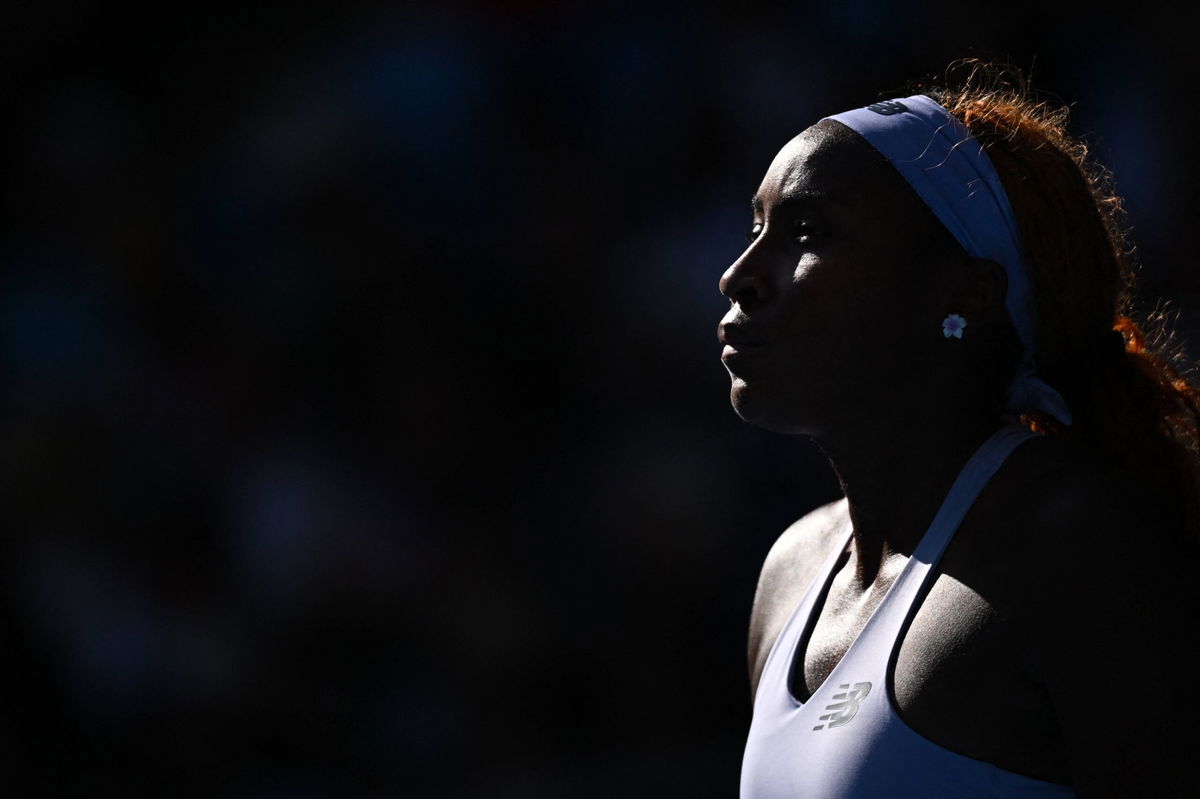
Australian Open – Melbourne Coco Gauff USA during her third match round at the 2026 Australian Open at Melbourne Park in Melbourne, Australia, on January 25, 2026. Photo by Corinne Dubreuil/ABACAPRESS.COM Melbourne Australia PUBLICATIONxNOTxINxFRAxUK Copyright: xDubreuilxCorinne/ABACAx
Imago
Australian Open – Melbourne Coco Gauff USA during her third match round at the 2026 Australian Open at Melbourne Park in Melbourne, Australia, on January 25, 2026. Photo by Corinne Dubreuil/ABACAPRESS.COM Melbourne Australia PUBLICATIONxNOTxINxFRAxUK Copyright: xDubreuilxCorinne/ABACAx
Last month, following a difficult quarterfinal loss to Elina Svitolina at the Australian Open, Coco Gauff was clearly overwhelmed with emotion. As she walked through a quiet corridor away from the court, she pulled a racket from her bag and smashed it against the concrete floor.
Watch What’s Trending Now!
What might have faded as just another post-match outburst, however, has since taken on a different meaning. The moment has now unexpectedly sparked what many are now describing as one of the more creative innovations in the sport.
Inspired by Gauff’s emotional moment in Melbourne, the ongoing ATX Open decided to think differently. Rather than simply policing frustration, organizers introduced a first-of-its-kind “rage room,” a private space where players can safely vent their emotions away from the public eye and cameras.
Top Stories





Coco Gauff’s reaction had already ignited conversations about athletes and their right to privacy, especially in vulnerable post-match moments. The ATX Open leaned into that discussion, creating a controlled environment where competitors can release frustration without fear of fines or viral clips.
After her quarterfinal defeat at the Australian Open last month, Coco Gauff needed a moment to let her frustration out.
She walked to a spot she believed was free of cameras and smashed her racket. But what she thought was a private release didn’t stay private for long.
Security footage surfaced online and quickly made the rounds on social media.
When she faced reporters later, Gauff responded with an awkward laugh. She admitted she genuinely believed she had found a camera-free area.

“I tried going somewhere where there are no cameras,” she explained.
At the same time, she was clear that her equipment had nothing to do with the loss.
“I don’t think that’s the reason why I lost today. I’m not picky with the rackets.”
Still, once the clip was out, the damage had already been done.
Professional tennis can push even the calmest players to their emotional limits. Some take a deep breath and move on. Others head straight to the locker room. And every so often, someone vents in a way that’s impossible to ignore. That’s why the idea of having a proper rage room built actually sounds pretty reasonable.
It’s also worth noting that this innovation comes at a time when players have been asking for more privacy off the court. Stars like Novak Djokovic and Iga Swiatek were among those who spoke up following the incident, calling for better boundaries when it comes to cameras and personal space.
And while Gauff nearly escaped a $50,000 fine, Serena Williams hasn’t always been so fortunate.
In an interview with Access Hollywood last month, she was asked why it’s important not to judge athletes too harshly for showing frustration during competition. Serena didn’t hold back.
“As an athlete, you work your whole life, in particular, for tennis for these Grand Slams. And when you get there, you have these expectations, you have this pressure. You go in there, thinking you’re going to win. And when it doesn’t happen, then things might be a little rough on that day.”
Then she added a bit of humor.
“Listen, I’m the queen of breaking rackets, literally. So, I was, like, ‘Oh my God, this is crazy.’ I did think she could have improved on breaking the racket. I do it in one swipe. I’ve demolished them in one swipe, so it should be humor. I mean, what’s the big deal? I mean, obviously, it’s whatever, who cares.”
Serena was fined $3,000 for breaking her racket during the 2018 US Open final, part of a total $17,000 penalty for three code violations. She was also fined $10,000 at Wimbledon Championships in 2016 and another $10,000 in 2019 for damaging a court with her racket.
Given that history, it’s easy to see why a rage room might actually help prevent further damage – both to equipment and to players’ wallets.
Meanwhile, Novak Djokovic and Jessica Pegula have both suggested there’s more to address than just the act itself.
Novak Djokovic stands by Coco Gauff amid privacy debate
“I see with what happened with Coco after her match,” Novak Djokovic said in his press conference after advancing to the semifinals of the Australian Open.
“Look, I empathize with her. I know what it feels like to break a racquet. I’ve done it a few times in my career. I know how it is to be frustrated, particularly after a match where you underperform.”
Coming from someone who has reportedly broken 62 rackets over the years, the comment carried weight. But for him, the bigger issue runs deeper than a smashed racket.
It’s about privacy.

Imago
TENNIS AUSTRALIAN OPEN, Novak Djokovic of Serbia speaks at a press conferene after loosing the mens singles final against Carlos Alcaraz of Spain on day 15 of the 2026 Australian Open tennis tournament at Melbourne Park in Melbourne, Sunday, February 1, 2026. NO ARCHIVING MELBOURNE VICTORIA AUSTRALIA PUBLICATIONxNOTxINxAUSxNZLxPNGxFIJxVANxSOLxTGA Copyright: xJOELxCARRETTx 20260202145146126202
“It’s really sad that you can’t move away anywhere and hide and fume out your frustration, your anger… in a way that won’t be captured by a camera. But we live in a society where content is everything. It’s a deeper discussion.”
Moreover, he doesn’t see that trend reversing anytime soon, either.
“It’s really hard for me to see the trend changing in the opposite direction, meaning we take out cameras. It’s only going to be as it is or even more cameras. I’m surprised we have no cameras while we’re taking a shower,” he joked, but clearly made a point about how constant the scrutiny feels.
Jessica Pegula echoed similar concerns.
After her quarterfinal win over Amanda Anisimova, she was asked about her fellow American’s situation.
“You’re under a microscope all day,” Pegula noted. “The only place you’re not filmed is the locker room or the bathroom. Coco wasn’t wrong. It’s an invasion of privacy, it’s very intrusive.”
For her, the frustration wasn’t just about the broken racket; it was about boundaries.
Despite the Australian Open heartbreak and a Round of 32 loss to Elisabetta Cocciaretto at the Qatar Open on February 10, Coco Gauff’s 2026 season has continued to struggle, with another quarterfinal defeat to Elina Svitolina at the Dubai Tennis Championships. Now, fans are left watching closely to see how the rest of her year unfolds.
Written by

Edited by

Ahana Chatterjee