
Imago
Image by danmir12 on Freepik
Imago
Image by danmir12 on Freepik
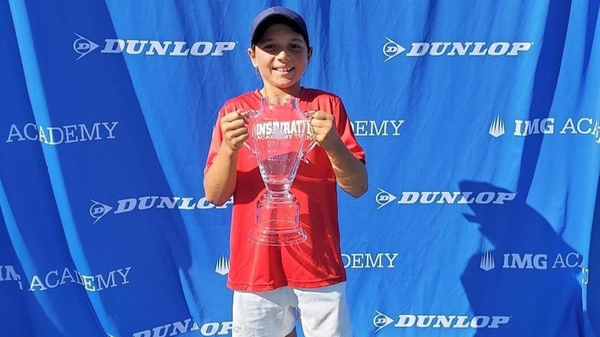
At just 15, Teodor Davidov is already challenging tennis norms. The ambidextrous teen has now earned his first professional ranking points, marking a significant milestone in a journey built on an unconventional idea that many once doubted.
Watch What’s Trending Now!
Davidov, currently ranked outside the top 300 among players aged 18 and under, recently reached the quarterfinals of a small pro event in Naples, Florida. While the result itself may seem modest, the bigger story lies in how he plays the game. Born in Sofia, Bulgaria, Davidov moved to Denver, Colorado, when he was just a year and a half old, before later relocating to Bradenton, Florida, a known tennis hub. But long before the move, his tennis identity had already begun to take shape.
Unlike traditional players, Davidov doesn’t rely on a backhand. Instead, he switches the racket between hands, striking forehands from both wings. The concept was born when he was eight, inspired by his father, who also serves as his coach.
Top Stories





“I discovered tennis when I was a baby. My father – who is now his coach – hung a tennis ball on a string and gave me a little racket. We started playing on a tennis court when I was two and a half,” he said.
“My father noticed that my left-handed forehand wasn’t so bad,” Davidov once shared in an interview with Babolat. “It was my father’s idea. My father first wanted to improve my coordination, but noticed that my left-handed forehand – he’s right-handed – wasn’t so bad. So, we started training him more and more.”
Despite criticism from skeptics unfamiliar with the style, those who see him live often walk away impressed. Many experts view the dual-forehand approach as an advantage, eliminating the typical weaker wing and allowing him to attack from either side without hesitation.
Davidov’s development hasn’t been accidental. His days are structured with precision. He wakes up at 6 a.m., trains on the court from 7 to 9:30 a.m., hits the gym, attends homeschool classes in the afternoon, and returns for another three-hour tennis session. On top of that, he practices Olympic weightlifting three times a week. Away from the court, he finds balance in skiing, fishing, surfing, and wakeboarding – activities that complement his athletic base.
Imago
Image Credits: IG/Teodor Davidov
In January 2024, Davidov claimed the doubles title at the 42nd edition of Petits As de Tarbes, one of the most prestigious junior tournaments in the world. The victory further validated his upward trajectory. In the short term, his focus remains on physical and mental growth – becoming stronger, faster, and more explosive. Long term?
Teodor Davidov reveals his long-term tennis goals
Teodor Davidov has never aimed small. The 15-year-old ambidextrous talent, already known for playing with two forehands, is once again making headlines – this time for opening up about his ultimate ambition in tennis. Currently ranked No. 2056 in the world, with a career-high of 2038 achieved on January 5, 2026, Davidov is still at the very beginning of his professional journey. But his long-term vision? It’s anything but modest.
“I don’t just want to be a professional player,” he has said. “I want to be the best tennis player of all time.”
Davidov’s unusual style has drawn attention from some of the sport’s sharpest minds. Renowned coach Patrick Mouratoglou has previously featured the Bulgarian-born prospect on his YouTube channel and praised the tactical upside of his game.
“Especially if you can serve with two hands, you have the ability on both sides of the court to hit the ball sharply wide and open up the court for yourself,” Mouratoglou explained, highlighting how an ambidextrous serve could stretch opponents and create immediate space.
Dutch left-hander Robin Haase also weighed in on the concept. Reflecting on Davidov’s two-handed approach, Haase admitted it could have been a serious weapon had he developed it early.
“I think I could have done it if I had practiced it early on, occasionally serving left-handed. That would have been a huge weapon,” he said.
Haase, who describes himself as ambidextrous in daily life, believes the concept isn’t as far-fetched as it sounds, provided coordination is developed early. Still, not everyone sees it as purely advantageous. Haase pointed to a subtle but significant challenge.
“The mental aspect,” he noted. “It has many advantages, but the more you can do, the more choices you have. And the more choices you have, the more you start thinking. And when you start thinking, you make mistakes.”
It’s a fascinating dilemma. While two forehands eliminate the traditional weaker wing, they also introduce tactical complexity. Decision-making speed at the highest level often determines outcomes, and overthinking can be costly. That’s where coaching and clarity come in.
Davidov remains confident that his two-forehand system can take him to the very top. At the same time, he continues to refine a conventional backhand – just in case the demands of elite tennis require adjustments. High ambitions? Absolutely. But do you consider Teodor Davidov one of the rising stars in the current era?
Written by

Edited by

Deepali Verma