Imago
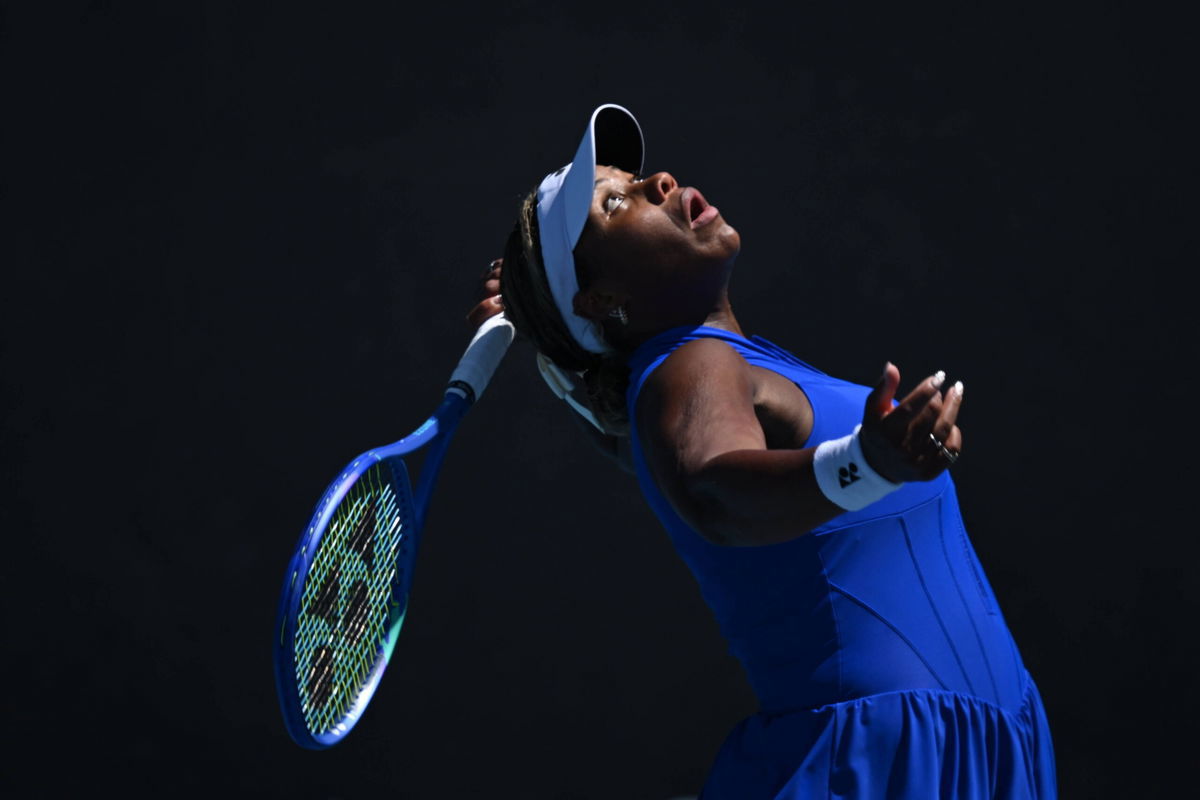
TENNIS AUSTRALIAN OPEN, Taylor Townsend of USA prepares to serve during the Womens 1st round match against Haley Baptiste of USA on day X of the 2026 Australian Open tennis tournament at Melbourne Park in Melbourne, Sunday, January 18, 2026. NO ARCHIVING MELBOURNE VICTORIA AUSTRALIA PUBLICATIONxNOTxINxAUSxNZLxPNGxFIJxVANxSOLxTGA Copyright: xJAMESxROSSx 20260118171248393178
Imago
TENNIS AUSTRALIAN OPEN, Taylor Townsend of USA prepares to serve during the Womens 1st round match against Haley Baptiste of USA on day X of the 2026 Australian Open tennis tournament at Melbourne Park in Melbourne, Sunday, January 18, 2026. NO ARCHIVING MELBOURNE VICTORIA AUSTRALIA PUBLICATIONxNOTxINxAUSxNZLxPNGxFIJxVANxSOLxTGA Copyright: xJAMESxROSSx 20260118171248393178
As the Australian Open doubles draw heats up in week two, Taylor Townsend remains impossible to ignore. The American has surged into the quarterfinals of both women’s and mixed doubles, making noise on court and off it. However, in hindsight, Townsend also delivered a hot take, boldly backing the girls’ serve amid Melbourne’s demanding conditions.


After reaching the mixed doubles quarterfinals with 37-year-old Nikola Mektić, Taylor Townsend delivered a bold on-court take. She said, “I feel like the guys really struggle with girls serve.” She then turned to the interviewer and asked, “What is your take?” Her comments drew laughter and attention.
Watch What’s Trending Now!
Townsend doubled down moments later. “Hot take: the guys can’t return the girls’ serve, sorry partner,” she added, as Mektić laughed beside her. The moment was lighthearted, playful, and instantly memorable for the crowd and viewers.
When the microphone moved to Mektić, he explained the challenge from his perspective. “It is different because you know, like, one game you are getting 200 km/h serves and then the next game you can get 125 km/h.” He stressed the adjustment required between points.
“Hot Take: The guys can’t return the girl’s serve” 👀@TaylorTownsend & @NMektic • #AO26 pic.twitter.com/OTholQeI72
— #AusOpen (@AustralianOpen) January 25, 2026
Mektić continued, “It is a very big difference. Also, its a little bit windy but we try.” As Townsend mocked him jokingly, she closed with, “I did. I built him up during the match, so now I can be free.”
Serve speed in women’s tennis has increased steadily over the years and players now generate more power and precision than ever before. While men still serve faster on average, the gap is narrowing as elite women continue to push the physical limits.
Several female players have recorded serves above 200 kilometers per hour. In 2018, Georgina Garcia Perez produced the fastest recorded women’s serve. During the Hungarian Ladies Open qualifying, she hit 220 km/h. That mark remains the highest ever measured in women’s tennis.
Aryna Sabalenka also crossed the 200 km/h barrier in 2018. She struck a 214 km/h serve at the Elite Trophy. Despite the speed, the record was never officially recognized by the WTA.
Earlier examples show this trend is not new. Venus Williams served at 207.6 km/h during the 2007 US Open. Serena Williams followed with a 207.0 km/h serve at the 2013 Australian Open, reinforcing her dominance.
Even so, men still generate higher speeds overall. On the ATP Tour, average first serves range between 190 and 200 km/h. On the WTA Tour, averages typically sit between 170 and 180 km/h.
Players like Giovanni Mpetshi Perricard show the extreme end of men’s serving. His serves regularly exceeds 200 km/h. The ball explodes off the racquet, leaving opponents with minimal reaction time.
Taylor Townsend recently challenged the common narrative around serve returns. Still, history and data suggest a consistent gap remains. Serve speed continues to be critical for success, and both tours rely on it as a key weapon.
Iga Swiatek reflects on rising serve speeds in modern tennis
Iga Swiatek capped a remarkable 2025 season by winning her sixth Grand Slam title and her first Wimbledon crown in July. It followed a difficult clay season with unexpected losses. She still finished the year ranked No. 2, an achievement she values deeply.
Despite that success, Swiatek believes future dominance may be harder. She feels the women’s game is becoming more competitive. The margins are shrinking, and the overall level continues to rise across the tour heading into 2026.
In a Clay interview last year, Swiatek addressed how serve speed has reshaped women’s tennis. “If I would serve, like, 185 kilometers per hour three years ago, I think it would be a game changer, and it would be amazing,” she explained.
She added, “But now (that) I actually learned to do that, I realized that girls are serving 195.” Swiatek stressed the broader point, saying, “It’s obviously not only about the speed. It is just an example.”
She continued, “But I think tennis is evolving and we’re all presenting a pretty good level now.” Her comments underline how power has become more common, not exceptional, in today’s women’s game.
As serving speeds increase, risk follows. Double-fault numbers remain higher on the WTA Tour compared to the ATP. Players push harder on serves to gain advantage, often accepting greater inconsistency as the trade-off.
During Riyadh title defense at the WTA Finals, Coco Gauff discussed her serve again after working with biomechanics coach Gavin MacMillan. “I would like to serve faster,” she said when asked about improvements.
She added, “With the serve, I feel like it was a good step.” Still, she clarified, “But I feel like that type of serving is what I can do when I feel like on an off day, but not how I would like to be on like an A-plus day.”
While comparisons between the two tours remain skewed by serve speed, women’s serving has clearly evolved. Even so, claims that men genuinely struggle with women’s serves are still difficult to justify today.
Written by

Edited by

Janainah Fazlin Anam