Imago
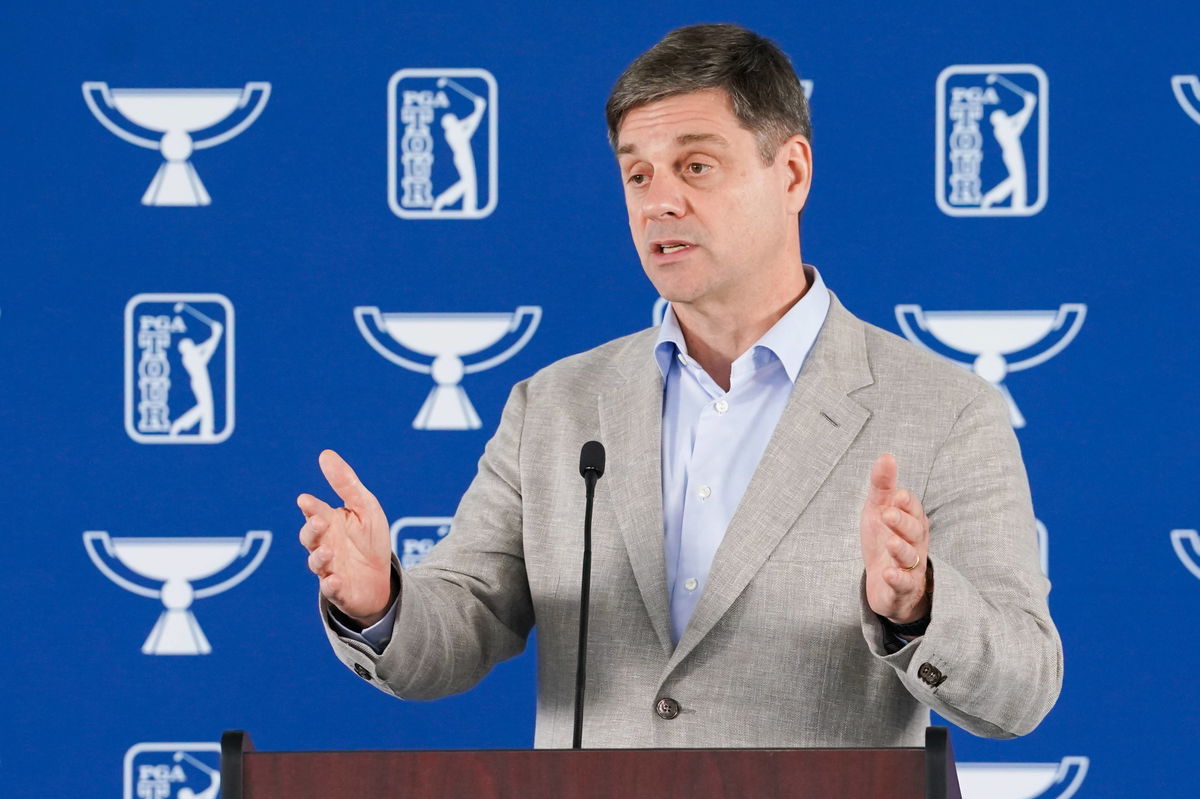
August 20, 2025, Atlanta, Georgia, USA: Brian Rolapp, Chief Executive Officer of the PGA, Golf Herren Tour, speaks to the media ahead of the 2025 TOUR Championship at East Lake Golf Club. Atlanta USA – ZUMAw109 20250820_fap_w109_012 Copyright: xDebbyxWongx
Imago
August 20, 2025, Atlanta, Georgia, USA: Brian Rolapp, Chief Executive Officer of the PGA, Golf Herren Tour, speaks to the media ahead of the 2025 TOUR Championship at East Lake Golf Club. Atlanta USA – ZUMAw109 20250820_fap_w109_012 Copyright: xDebbyxWongx
The PGA Tour spent years fighting LIV Golf’s threat to its identity. Now, under new CEO Brian Rolapp, it faces a different battle: one from within its own membership.
Watch What’s Trending Now!
Kevin Kisner made that tension clear during his December 5 appearance on Trey Wingo’s ‘Straight Facts Homie!’ podcast. The four-time PGA Tour winner praised Rolapp’s leadership and acknowledged the Tour’s stability post-LIV. But his language revealed something else entirely. Wedged between optimism and endorsement sat three words that exposed the fracture: “I’m not in love.”
“I’m not in love with the designated or whatever they’re called events, signature events,” Kisner said. “You don’t really need to have two different levels of the tour. Let’s just have 25 events. They all matter the same, and all the sponsors matter the same.”
ADVERTISEMENT
Kisner was talking about signature events. The limited-field tournaments that defined the Tour’s 2024 and 2025 restructuring. And his discomfort wasn’t subtle. His preference was direct. A unified structure where meritocracy still determined outcomes. Not a tiered system that separates the elite from everyone else.
“But I think Brian, I’ve talked to Brian Rolapp, the new CEO, a bunch, and I think he’s a great guy, and he really has some strategic ideas on how to elevate our game, elevate the game to the fans, and uh really take this whole organization to the next step,” Kisner explained about his meetings with Rolapp. He added, “So, he’s got a lot of great guys working for him and with them, and I feel good about it.”
To sum it up, that’s the friction Rolapp now faces. He arrived in June 2025 after more than two decades with the NFL as Chief Media and Business Officer. His resume includes creating Thursday Night Football and negotiating media deals worth over $110 billion. His mandate at the PGA Tour is similar: maximize engagement and apply NFL-style efficiency to golf’s traditional structure.
ADVERTISEMENT
But the signature events model creates opportunity gaps. Fields feature 70-80 players, $20 million purses, and 700 FedEx Cup points for winners. Five events have no cuts. Three player-hosted invitationals retain 36-hole cuts to the top 50 and ties.

USA Today via Reuters
Sep 20, 2022; Charlotte, North Carolina, USA; Team USA golfer Kevin Kisner stands on the 14th green during a practice day for the Presidents Cup golf tournament at Quail Hollow Club. Mandatory Credit: Peter Casey-USA TODAY Sports
Players like him, who earned over $29 million in career earnings, still feel the squeeze. He represents the Tour’s veteran class—players who thrived under traditional meritocracy but now face limited access to the biggest purses.
ADVERTISEMENT
And Kisner wasn’t afraid to name the risk.
“Now, you’re going to have to lose some title sponsors when you get fewer events,” he said. “And how many people are you going to frustrate that don’t want to be strategic partners with you? I’m not smart enough to do that, but that’s why Brian’s got the job.”
ADVERTISEMENT
It was support. But it was also distancing.
Top Stories
Bryson DeChambeau Visits PGA of America as LIV Golf’s Future Looks Bleak
Bryson DeChambeau Announces Career Move After $500M Demand Put LIV Golf in Worrying Spot
Patrick Reed Cuts Ties With LIV Golf as He Commits to PGA Tour With Public Message
Charley Hull Stands Her Ground After Nelly Korda Disapproved of Her Involvement in New Women’s League

Hideki Matsuyama Lashes Out at PGA Tour as Brooks Koepka Returns Without Serving Any Suspension

Brian Rolapp’s NFL strategy divides PGA Tour players
Other players have been more direct. Jake Knapp, defending Mexico Open champion, told GOLF’s Subpar podcast he hadn’t heard anyone support the new direction “other than the top 10 dudes in the world that seem to be calling the shots.” Lucas Glover called signature events a “money grab” and “selfish.”
ADVERTISEMENT
Even analysts raised alarms. Eamon Lynch from Golfweek warned that Rolapp’s NFL instincts—focused on American football season avoidance—could harm golf’s year-round, global fan base. “Rolapp’s last job involved catering to NFL fans,” Lynch wrote. “He shouldn’t make the mistake of thinking his current job asks the same.”
Yet Rolapp’s strategies reflect his NFL roots. He’s exploring a post-Super Bowl season start to avoid viewership battles with football. The logic is sound. Golf can’t compete with the NFL playoffs and Super Bowl, which dominate U.S. sports media in January and February.
Kisner agreed with the approach. At least partially but he also embraced Rolapp’s broader philosophy.
ADVERTISEMENT
“From a weather standpoint, why do we go to California in January when it’s fantastic there in March?” he said. “Obviously, we know we can’t compete with the Giant of the NFL.”
When Wingo mentioned Rolapp’s statement, “We will honor the traditions, but we won’t be bound by them,”Kisner didn’t hesitate. “I agree with that totally,” he said. “Just because it’s all the way you’ve always done it doesn’t mean it’s right.”
That’s the paradox Kisner embodies. He supports modernization. He trusts Rolapp’s vision. He acknowledges the Tour is healthier post-LIV. “I think the threat of them taking top players and us losing our product is pretty much gone,” he said.
ADVERTISEMENT
Yet his reservations about signature events and sponsor fallout reveal the fundamental tension. Can the Tour adopt NFL-style efficiency without losing the meritocratic identity that differentiated it from LIV?
At a recent Hero World Challenge meeting, Tiger Woods and Rolapp discussed major changes coming in 2027. Scottie Scheffler praised Rolapp’s ideas and called him “very smart and knowledgeable.” But Brian Harman offered a warning. “Change is hard,” Harman said. “In every situation, there’s going to be people that benefit and people that don’t benefit.”
Kisner’s comments suggest he’s caught between those outcomes. He’s vocal enough to express concern. Pragmatic enough to defer to leadership. But uncertain whether the changes will preserve the opportunities that built his career.
ADVERTISEMENT
“I think they got a huge strategic decision on what the schedule starts to shake out,” Kisner said. And then he placed his faith where it needed to go. “I’m going to trust that he’s going to make the best decisions for the players and our equity stakes in the PGA Tour, and we all want them to succeed because then we all make more money.”
It’s guarded optimism at its finest. Public endorsement wrapped around quiet skepticism. And it reveals the question now facing Rolapp’s leadership: Will his business-first approach strengthen the Tour or alienate the very players and sponsors it needs to succeed?
ADVERTISEMENT
ADVERTISEMENT
ADVERTISEMENT
Related Newsletters