Imago
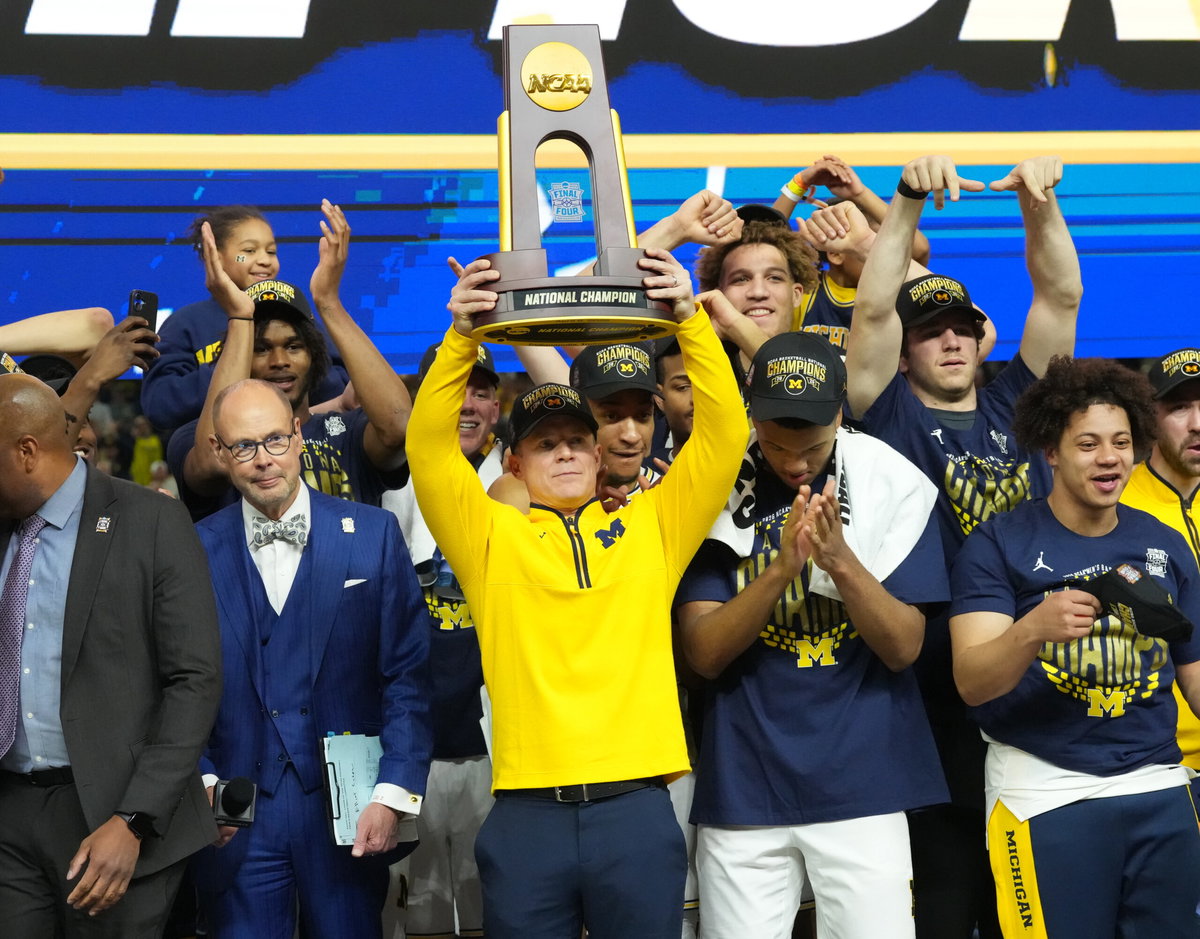
Apr 6, 2026; Indianapolis, IN, USA; Michigan Wolverines head coach Dusty May hoists the trophy after defeating the Connecticut Huskies in the national championship of the Final Four of the men’s 2026 NCAA Tournament at Lucas Oil Stadium. Mandatory Credit: Robert Deutsch-Imagn Images
Imago
Apr 6, 2026; Indianapolis, IN, USA; Michigan Wolverines head coach Dusty May hoists the trophy after defeating the Connecticut Huskies in the national championship of the Final Four of the men’s 2026 NCAA Tournament at Lucas Oil Stadium. Mandatory Credit: Robert Deutsch-Imagn Images
Before the first nylon string could be snipped from the basket after Michigan’s 69-63 Finals win over UConn, the question arose in the confetti-filled air of Indianapolis’ Lucas Oil Stadium.
Watch What’s Trending Now!
Where does this year’s Wolverine team stand among the NCAA’s all-time champions? The debate isn’t whether or not Dusty May’s squad is great. The question is, just how great?
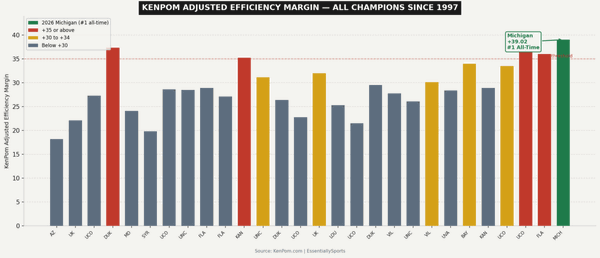
The 2026 Wolverines registered a KenPom adjusted efficiency margin of +39.02, the highest ever clocked by the renowned college basketball rating system.
Top Stories






Michigan is one of, if not the most prolific national champions in the modern era. But KenPom only dates back to the 1996-97 season. The ghosts of some legendary college champs would like to have their say in the matter.
THE GENERATION PARADOX
It’s a debate as old as sport itself. How would today’s greats stack up against the heroes of the past?
College basketball in 2026 looks much different than it did in 1976 before the incorporation of elements such as the three-point line, shot clock and, even, a 64-team tournament.
But that’s not to say a fair comparison can’t be traced across the eras.
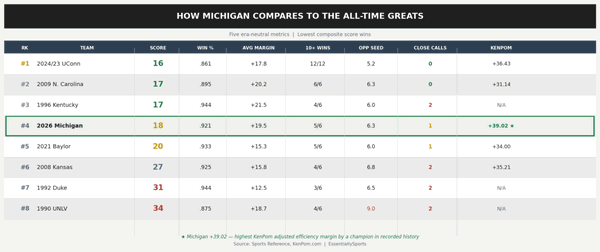
Enter the Essentially Sports equation which tabulates a composite score based on five components: regular season win percentage, average margin of tournament victory, double-digit tournament wins, average opponent tournament seeds beaten and close calls, which we define as tournament wins by fewer than 10 points.
Think of it like golf. The lower the score, the better.
The metric is designed to level the playing field across the decades and avoid any era bias. But first we’ll focus on the modern age. Eight historically-dominant teams made the cut from UConn’s recent mini dynasty to Tark and the Runnin’ Rebels. Each can make their own GOAT claim.
But the numbers create a hierarchy of greatness. Behold, the Essentially Sports All-Time Elite Eight.
THE LOWER TABLE
The image of Jerry Tarkanian biting towel after towel to manage his stress is indelibly linked to his 1990 UNLV squad. The Runnin’ Rebels became the only team in NCAA tournament history to average 95 points per game en route to routing Duke by 30 in the championship contest.
But the numbers reveal a team with the weakest path among our Elite Eight, courtesy of the lowest win percentage among opponents in the field (.875), an average opponent seeding of 9.0 and two close calls, including a near upset loss to Ball State in the Sweet 16.
The lore of Christian Laettner and Duke is one that grows grander with time. Yet, the famous buzzer beater? It was indicative of a tournament run where the Blue Devils’ 12.5 average margin of victory is the lowest in our Elite Eight. Duke edged Indiana by three points and needed overtime to eke past Kentucky by a point. For as great as Michigan’s Fab Five was, they entered the Finals that year against Duke as a No. 6 seed.
The 2008 Kansas Jayhawks racked up a KenPom score of +35.21. Yet Bill Self’s crew was nearly clipped by Memphis in overtime and had to clamp down before Steph Curry could get off the buzzer beater in the final seconds versus Davidson.
It’s not that these teams weren’t iconic. They simply rank Nos. 6-8 in our Elite Eight composite. The true greatness is just beginning.
THE “MIDDLE” TIER
The best regular season win percentage among our Elite Eight belongs to the 2021 Baylor Bears.
The Bears steamrolled competition with a 28-2 (.933) regular season, with a KenPom rating of +34, fourth-best on our list. Baylor won five of their six March Madness games by double digits, including a 16-point win over undefeated Gonzaga in the Finals. The Bulldogs would be in this conversation had they won, but their strength of schedule would be a deterrent.
It’s impossible to discount, however, the shortened season due to COVID. The Bears had a lengthy midseason pause to rest, but did handle whoever was in front of them with a nearly flawless year.
Yet, despite their sheer dominance, they still find themselves gazing up at the Final Four on our list.
THE FINAL FOUR
Here’s where the debate truly begins. A mere two points separates our No. 4 team from our top squad.
NO. 3T – 1996 KENTUCKY WILDCATS
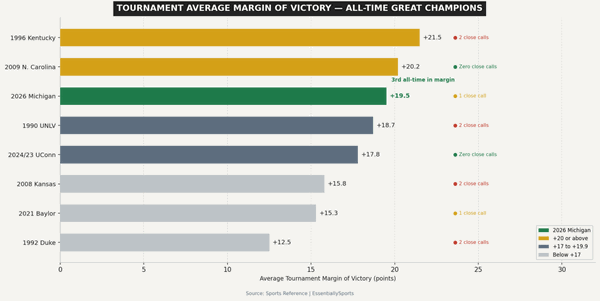
Rick Pitino’s 1996 Kentucky squad featured nine future NBA players. As you can imagine, the Wildcats simply bullied opponents with an average margin of +21.5, tops in our Final Four. Kentucky finished 34-2 and won their first four March Madness games by an average of 28 points.
The problem, however, is the lack of KenPom data. Without it, there’s an argument to be made for the Wildcats to claim the top spot.
NO. 2T – 2009 NORTH CAROLINA TAR HEELS
The 2009 North Carolina Tar Heels might be one of the most overlooked teams ever.
Roy Williams’ program ran the tournament table, winning all six of their games by double-digits. All totaled, their average margin of +20.2 ranks them slightly ahead of 1996 Kentucky with their consistency and stronger path giving North Carolina the edge.
NO. 1 – 2023/2024 UCONN HUSKIES
Speaking of consistency, no one did it better than the 2023 and 2024 UConn Huskies.
Granted, we’re taking the average of UConn’s two-year run as one, but it’s impossible to ignore a team that won 12 of its 12 tournament games over that span all by double digits. We’re talking zero close games against the strongest strength of schedule among our Elite Eight teams with an average opponent seeding of 5.2.
It’s dynasty territory, or as close as you can get since Florida went back-to-back in 2006 and 2007.
The knock on Dan Hurley’s squad is they tended to underperform in the regular season, losing eight games in those two years for an .861 winning percentage. If regular season record was weighted more heavily in our algorithm, it’s likely the Huskies drop from the top spot.
Legends are made in March, however.
NO. 4 – 2026 MICHIGAN WOLVERINES
So where does this year’s champion Michigan land on the list? One point behind the leaders. Just one point.
The Wolverines claimed the highest KenPom score ever at +39.02 and an Essentially Sports tournament average margin of +19.5, ranking them third in that category.
Michigan mauled five of their six tournament opponents to the tune of double-digit victories. Their only close call came in the Finals against a UConn team that still has key players remaining from its aforementioned dynasty run. And even then, the game was never really in danger for Dusty May’s squad.
With such a fine line, any one of these teams can stake a claim as the best ever in the modern era. Then, of course, you have the old school champs who would like a word.
THE LEGEND OF THE LEGENDS
The college basketball purists will tell you that the John Wooden-era UCLA Bruins would handle the 2026 Michigan Wolverines properly. Or that the 2009 North Carolina would have no shot against the 1976 Indiana Hoosiers. When the tournament expanded to 64 teams in 1985, it closed the door on the pre-modern era, taking some of the greatest teams ever into the vault with it.
With a lack of data, the only way to settle the issue is with a good-hearted debate:
1974 NC STATE – David Thompson and the Wolfpack went 30-1, but their dominance is often lost to history. UCLA remembers NC State. The Wolfpack not only beat the Bruins in the 1974 Final Four, they ended UCLA’s run of seven-straight national titles.
1979 MICHIGAN STATE – Sophomore Magic Johnson took down an undefeated Indiana State team in the highest-rated college basketball game in broadcast history. The rivalry with Larry Bird was born that day, but it never happens without the powerhouse Spartan team. If Bird and the Sycamores emerge victorious, it’s likely them in this spot on the list.
1982 NORTH CAROLINA – Michael Jordan nailed the clutch late shot as Dean Smith finally won his first title with a team that featured three future college basketball hall-of-famers in Jordan, Sam Perkins and Most Outstanding Player James Worthy.
1976 INDIANA HOOSIERS – Many have come close in the last 50 years, but none have been able to complete the perfect season since the 1976 Indiana Hoosiers. Bob Knight’s team went 32-0 and the fiery legend was born.
UCLA/JOHN WOODEN – It’s a tall task to pick just one of the many thrilling UCLA teams anchored by the likes of Lew Alcindor, Bill Walton and beyond. Arguably one of the greatest stretches in sports history, the Bruins went 335-22, won 10 national titles in 12 seasons and established the definition of what it is to be a dynasty.
It’s difficult to say who would emerge victorious should any of these teams play. They didn’t just win championships. They set the gold standard by which the 2026 Michigan Wolverines and others will be judged.
THE LANDING
Where does this year’s Michigan team land after the last of the confetti falls from the rafters?
Depends on your metric. The composite score says fourth overall, but separated by a single point from the all-time greats. The highly regarded KenPom, conversely, says the Wolverines are statistically the undisputed champion.
The numbers tell a story. The ghosts share their own tales. The 2026 Michigan Wolverines are in history’s hands now and one day the next great champion will be compared to them.
Written by

Edited by

Snigdhaa Jaiswal