
Imago
Sep 30, 2024; San Francisco, CA, USA; Golden State Warriors forward Jonathan Kuminga (00) poses for a photo during Media Day at the Chase Center. Mandatory Credit: Cary Edmondson-Imagn Images
Imago
Sep 30, 2024; San Francisco, CA, USA; Golden State Warriors forward Jonathan Kuminga (00) poses for a photo during Media Day at the Chase Center. Mandatory Credit: Cary Edmondson-Imagn Images
The Golden State Warriors’ trade deadline move wasn’t as straightforward as it looked. While the franchise ultimately shipped Jonathan Kuminga and Buddy Hield to Atlanta in exchange for Kristaps Porzingis, that deal was reportedly far from their best option.


According to a new report, the Warriors had a more appealing offer on the table, one that would’ve addressed immediate needs and provided a better long-term fit. Yet despite strong interest from a division rival, the front office chose to pass.
Watch What’s Trending Now!
The reason, apparently, had little to do with basketball logic. Internal locker-room dynamics played a major role in shaping Golden State’s final decision, blocking a move that could’ve reshaped the roster in a very different way. “The warriors don’t have a lot of fans, from what I’ve heard, a lot of Malik Monk fans in their locker room,” Warriors insider John Dickinson said recently.
“And it’s twofold. It’s basically one; he did stand up on the podium in between game six and game seven on that Saturday afternoon, where Steph Curry was imploring young players who want to get on the bus and go to Sacramento.”
Could the Kings have used Malik Monk’s deal to make a trade with the Warriors?
Well, some Golden State players don’t seem to be fans of Monk for a couple of reasons.@JDJohnDickinson: “I had heard that Monk would not have been the most welcomed player (in the Warriors locker… pic.twitter.com/qqH9wQJW4f
— Sactown Sports 1140 (@Sactown1140) February 6, 2026
“He basically called the Warriors old and busted, Monk did,” Dickinson further explained. “In between game six and game seven, after the Kings had gone into Chase Centre and dominated game six to even the series. And so he basically called the Warriors old and busted and cooked, and then Steph went in there and dropped 50 on them in game seven and said, ‘not so fast.'”
Monk and the Warriors stars, such as Stephen Curry and Draymond Green, have a long history, especially after their thrilling playoff series in 2023. It was then that the Kings’ guard called the Dubs’ veteran core “old” and suggested that the younger Sacramento players would wear them down, a suggestion that seemed to stick with Steph, as he dropped 50 points in game seven to hand his team the win.
A Malik Monk deal would have been close to perfect for Golden State because it would have directly addressed their biggest on-court weakness: downhill creation and second-unit offense. Unlike Kristaps Porzingis, Monk fits seamlessly into the Warriors’ motion, split-cut, and read-and-react ecosystem while offering better role clarity and fewer availability concerns.
Monk represents exactly the archetype Golden State’s offense has lacked: an on-ball scorer who can also function as an off-ball mover and secondary handler next to Stephen Curry. His game is built on quick-hitting pick-and-rolls, relocations, and attacking tilted defenses, all of which map directly onto the Warriors’ motion sets where guards must shoot, drive, or swing without stopping the ball.
As Mike Loginoff on Locked on Warriors admitted, “Malik Monk is exactly the player, the archetype of player that the Warriors need.”
This matters because Golden State’s most persistent issue has been generating reliable offense when Curry sits and creating paint pressure to avoid late-clock jumpers. Monk targets that weakness head-on as a sixth-man microwave scorer who can stabilize bench lineups that have historically bled leads when relying on young wings or non-creation guards.
By contrast, Porzingis addresses size, rim protection, and stretch-five spacing. Real needs, but ones partially covered by Draymond Green and small-ball units. Those strengths don’t matter much if the team can’t score against set defenses or survive non-Curry minutes, which is where Monk’s ability to attack closeouts, run pick-and-roll with second units, and score in bunches would have made an immediate impact.
Nonetheless, Monk’s harsh comments weren’t the only factor influencing how the Dubs’ players viewed him. The firing of former Kings head coach Mike Brown, who was a former Warriors assistant, also played a major role, as he reportedly had issues with Monk during his time at the helm in Sacramento.
Brown publicly discussed the challenges of integrating Monk into the starting lineup during the 2024-25 season, trying to balance his offensive firepower with defensive schemes as the team struggled to find consistency. While Monk posted solid bench numbers, he drew scrutiny for inconsistent effort on that end of the floor.
The tension came to a head in a January 2024 loss to the Hornets, when Brown and Monk exchanged heated words during a timeout after Monk showed visible frustration following his made three-pointers. He finished the game with a poor -21 plus-minus. Afterward, Brown downplayed the incident as “heat of the moment,” acknowledging the ongoing “push and pull” in their relationship as they worked to maximize Monk’s role.
While the Warriors’ reported reluctance to acquire Malik Monk stems from specific bad blood, particularly his 2023 playoff comments dismissing the team’s veteran core as ‘old and busted,’ this isn’t entirely unique in NBA history.
A notable precedent came in 2011 when the NBA itself vetoed a blockbuster trade sending Chris Paul to the Lakers, partly due to concerns over competitive balance and resistance to further empowering a rival franchise’s star players.
Closer Look at how the Kristaps Porzingis Trade Impacts the Warriors
Jonathan Kuminga has gone, but the season goes on. So, where do the Golden State Warriors go from here? Well, if we’re being honest, things don’t look too great for the historic franchise. The Warriors currently sit 8th in the Western Conference with a 28-24 record. So, despite there still being 30 games available, the hopes of them winning a Larry O’Brien Trophy seem grim.
More so, because the Warriors have already lost Jimmy Butler to a season-ending ACL tear (suffered January 19, 2026, with surgery scheduled for February 9). Not to mention their high-profile but unsuccessful pursuit of Milwaukee Bucks superstar Giannis Antetokounmpo ahead of the February 5 trade deadline.
The Warriors made serious offers—including packages reportedly built around Jonathan Kuminga, Draymond Green, and significant draft capital—but the Bucks ultimately kept Antetokounmpo off the market at that time. That failed chase prompted Golden State to pivot, trading Kuminga and Buddy Hield for Kristaps Porzingis instead.
Imago
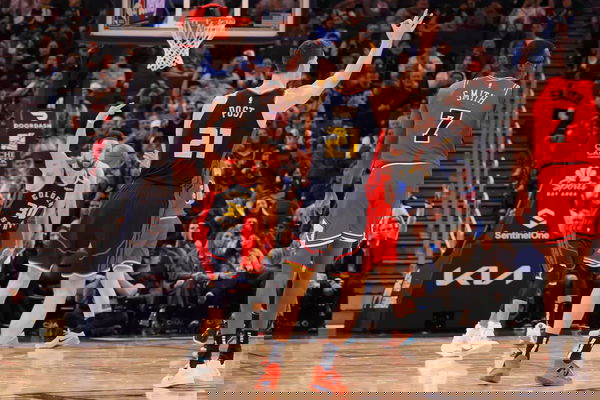
Jan 23, 2025; San Francisco, California, USA; Golden State Warriors center Quinten Post (21) celebrates with guard Stephen Curry (30) after scoring a three point basket against the Chicago Bulls during the fourth quarter at Chase Center. Mandatory Credit: Kelley L Cox-Imagn Images
Nonetheless, that will only boost his stock and help him get back to serious business next season. That’s because the Warriors will have the entire summer to figure out what fits their timeline and whether they should keep Jimmy Butler until his return.
Kristaps gives the Warriors the stretch-five they’ve chased for years: a floor-spacing seven-footer who can score at all three levels and protect the rim, reshaping both their offensive geometry and back-line defense if he stays healthy.
As a 36–37% career three-point shooter, he can pop beyond the arc, roll for lobs, and punish mismatches in the post. When teams trap Curry or send two to the ball, having KP slip or pop into space forces opposing bigs to defend at the three-point line.
This opens up cuts for wings and creates short-roll playmaking opportunities for Draymond Green, essentially the old Warriors “Spain” pick-and-roll and split-cut actions, but now with a 7’3″ sniper setting the screen instead of a non-shooting center. Defenses face an impossible choice: either drag their rim protector out to the perimeter or give up a clean above-the-break three.
Defensively, he transforms their back line by altering and blocking attempts near the basket. Teams can’t bully him in the post the way they could smaller centers, giving Golden State a legitimate rim presence they’ve sorely missed.
Written by

Edited by

Tanay Sahai