Imago
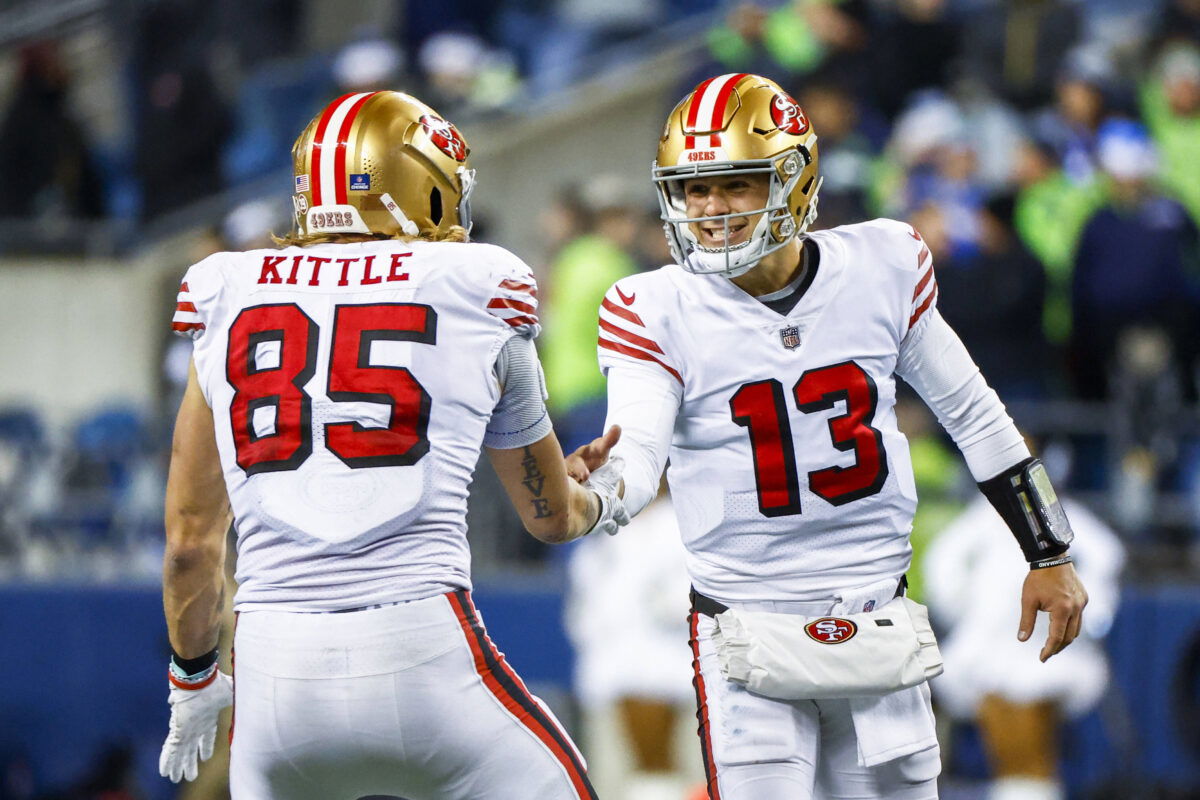
NFL, American Football Herren, USA San Francisco 49ers at Seattle Seahawks Dec 15, 2022 Seattle, Washington, USA San Francisco 49ers quarterback Brock Purdy 13 celebrates with tight end George Kittle 85 during the late fourth quarter against the Seattle Seahawks at Lumen Field. Seattle Lumen Field Washington USA, EDITORIAL USE ONLY PUBLICATIONxINxGERxSUIxAUTxONLY Copyright: xJoexNicholsonx 20221215_jmn_sn8_029
Imago
NFL, American Football Herren, USA San Francisco 49ers at Seattle Seahawks Dec 15, 2022 Seattle, Washington, USA San Francisco 49ers quarterback Brock Purdy 13 celebrates with tight end George Kittle 85 during the late fourth quarter against the Seattle Seahawks at Lumen Field. Seattle Lumen Field Washington USA, EDITORIAL USE ONLY PUBLICATIONxINxGERxSUIxAUTxONLY Copyright: xJoexNicholsonx 20221215_jmn_sn8_029
The first round of the NFL Draft is one of the biggest spectacles in sports, with thousands of fans flocking to watch 32 college kids’ dreams come true on a Thursday night. But championship rosters aren’t built on Thursday night; they’re forged in the value-rich middle and late rounds of the draft.

Every year, tons of players fly under the radar and are drafted way later than they should be. Whether they didn’t have great tape in college, or they didn’t have the physical attributes of their peers, or they didn’t interview well, it doesn’t matter.
Watch What’s Trending Now!
In the latest edition of EssentiallySports’ DraftCast with Tony Pauline, he broke down 10 players who were undervalued as prospects, but overperformed once they got to the league.

Where Does Osu Still Lack Elite Talent?
Let Tony do the scouting, you just make the pick.
Pick your positions. Get Tony’s top 5:
George Kittle
Imago
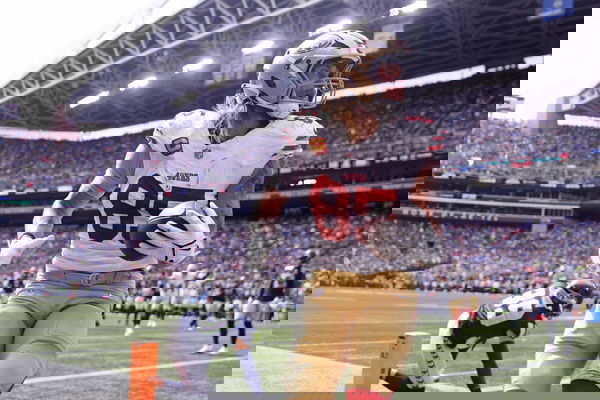
NFL, American Football Herren, USA San Francisco 49ers at Seattle Seahawks Sep 7, 2025 Seattle, Washington, USA San Francisco 49ers tight end George Kittle 85 celebrates after scoring a touchdown during the first half against the Seattle Seahawks during the first quarter at Lumen Field. Seattle Lumen Field Washington USA, EDITORIAL USE ONLY PUBLICATIONxINxGERxSUIxAUTxONLY Copyright: xJoexNicholsonx 20250907_tdc_sn8_618
Draft Position: Round 5, Pick 146
George Kittle kicks off our list, a prime example of an undervalued prospect who thrived in the NFL. The San Francisco 49ers tight end has been one of the best tight ends in the sport for the better part of a decade, and if it weren’t for injuries, he’d be a lock for the Hall of Fame.
Coming out of college, he was far from a complete prospect, though. While he was a great athlete at Iowa, a school that has always produced great tight ends, he didn’t appear to be a polished, NFL-ready prospect.
“He was an athlete who had to become a football player,” said Pauline. “You look at his production at Iowa, I think he caught 42 passes in his last two seasons. He was a guy who had the physical skills, but hadn’t become a football player.”
The 49ers developed him quickly, and he was a 1,000-yard receiver by his second season in the league. Coaching has always and will always matter. If he had gone to a different situation, who knows what he would’ve become?
Brock Purdy
Draft Position: Round 7, Pick 262
Another extremely undervalued guy was Brock Purdy. He was Mr. Irrelevant in 2022, but ever since he took over as the starter late in his rookie year, he hasn’t looked back. He led the 49ers to the Super Bowl in 2023 and has thrown for 3,800+ yards in two of his three full seasons.
Coming out of college, Purdy was a lot like Tom Brady. He was a very cerebral quarterback, but his physical traits were nothing special. But he landed in the perfect situation with Kyle Shanahan, and now Purdy is viewed as one of the top passers in the league.
“The irony of that was, the year before, San Francisco traded all that draft capital to move up to the third spot for Trey Lance, and he’s been an absolute bust,” said Pauline. “Purdy is one of those guys who gets it between the ears…He didn’t look like anything great. Jimmy Garoppolo, a few years earlier, was fantastic at the Shrine Bowl and moved into the second round. With Purdy, you came out of it thinking he’s a nice backup quarterback. He’s a No. 2 guy, he’s a short-range passer, and he’s not going to wow anybody, but he got hooked up with the right coach.”
DK Metcalf
Draft Position: Round 2, Pick 64
DK Metcalf was a fascinating prospect coming out of college. He was a physical specimen, but he was not a very well-rounded receiver. He relied on his physical traits to win in college, but he’d need a lot of refinement once he got to the league.
“I saw a guy who was great in a straight line,” Pauline explained. “Obviously, he looked like a power forward on the football field. But I saw someone who needed to improve his route tree and improve his playing balance. What really wowed people was at the combine, when he ran in the 4.3s, and no one expected him to be that fast.”
Metcalf was able to make those adjustments in Seattle. In his first season, he went for 900 yards, but after that, he logged 1,000+ yards in three of the next four seasons. He hasn’t hit the 1,000-yard mark in his last two years, but he’s become a much more well-rounded receiver since entering the league.
Antonio Brown
Draft Position: Round 6, Pick 195
Antonio Brown had all the tools to be an elite NFL receiver, but he didn’t play much competition at Central Michigan, and he was a bit undersized. Pauline called him one of his favorite college receivers of the past three years when he came out, but his size and lack of competition were big red flags.
“I loved him,” said Pauline. “If you looked at my scouting report, it says Brown is one of my favorite receivers in college over the past three years. He lacked size, but he was fast, and he was basically the game-controlling receiver at the college level that Metcalf has turned out to be at the pro level. Everything was there, but the thing with Brown was, coming out of Central Michigan, he didn’t play in a big-time conference.”
Neither of those things mattered for Brown. He became an elite route runner, and his speed allowed him to separate from defensive backs in a straight line. Incredibly, one of the best receivers in NFL history fell to the sixth round.
Puka Nacua
Imago
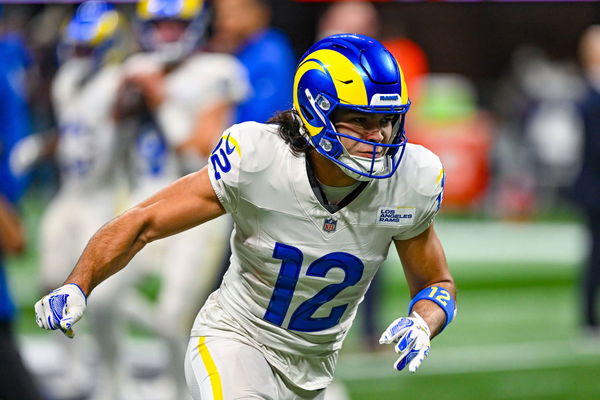
ATLANTA, GA – DECEMBER 29: Los Angeles wide receiver Puka Nacua 12 warms up prior to the start of the NFL, American Football Herren, USA game between the Los Angeles Rams and the Atlanta Falcons on December 29th, 2025 at Mercedes-Benz Stadium in Atlanta, GA. Photo by Rich von Biberstein/Icon Sportswire NFL: DEC 29 Rams at Falcons EDITORIAL USE ONLY Icon251229096
Draft Position: Round 5, Pick 177
The theme of overlooked receivers continues with Puka Nacua, who fell to the fifth round because he wasn’t a great athlete, but sometimes all you have to do is just catch the football.
“I loved Nacua at BYU,” Pauline said. “Absolutely loved him. I had him as a third-round pick…His agent said, ‘I think he’ll be a fifth-round pick.’ I asked why, and he said ‘well he didn’t test well.’ He doesn’t run really fast, he doesn’t jump very high…He’s going to get downgraded because of his testing numbers.”
Nacua is the perfect example of testing not mattering. Yes, most of the time, a slow and unathletic receiver doesn’t work in the NFL, but sometimes all you have to do is watch the tape. He was a beast at BYU, but the NFL undervalued him because of a couple of numbers on a sheet.
Stefon Diggs
Draft Position: Round 5, Pick 146
Stefon Diggs is another receiver who slipped through the cracks and fell to the fifth round. Unlike Nacua, his testing numbers were solid. People were just concerned with his size coming out of college.
“The biggest negative was his size, because he wasn’t very big,” Pauline explained. “Is he gonna be a slot receiver? How is he going to handle the next level? Is he going to be able to handle press coverage? Things like that. But the sheer speed and pass-catching ability, you’re like, ‘wow.’ I had him as a third or fourth round pick.”
This is another instance of sometimes you need to let the tape do the talking. If you watch a guy play and he makes your jaw drop constantly, maybe he’s going to be a good football player regardless of his size.
Amon-Ra St. Brown
Draft Position: Round 4, Pick 112
Amon-Ra St. Brown is undersized as well, but that isn’t necessarily why he fell in the draft. In college, he had a really strong freshman and sophomore season, but had just 450 yards on 41 catches as a junior. He still decided to declare for the draft, but there were a lot of questions he had to answer about what happened in his junior season.
“I think the problem with St. Brown was that he was better at the start of his college career than he was when he entered the draft. When a guy comes off a bad year, you’ve got to find out why, make sure it’s not going to continue, and you’ve got to turn that around…The situation was, was his best football behind him? Or was his best football in front of him?”
Ultimately, his best football was still ahead of him, a fact he quickly proved in the NFL. He has developed into one of the best receivers in the league, and it may not have happened if it weren’t for the chip on his shoulder after sliding in the draft.
Isiah Pacheco
Imago
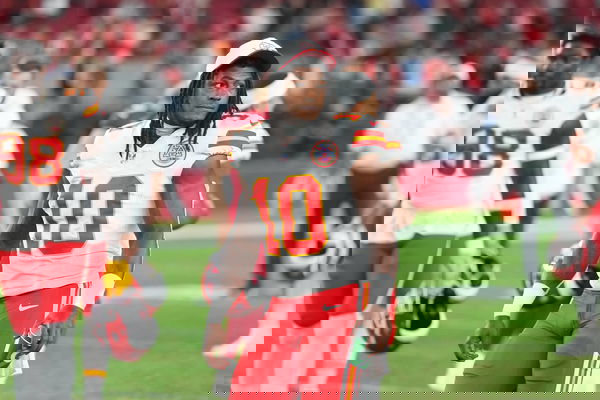
NFL, American Football Herren, USA Kansas City Chiefs at Arizona Cardinals Aug 9, 2025 Glendale, Arizona, USA Kansas City Chiefs running back Isiah Pacheco 10 after the game against the Arizona Cardinals at State Farm Stadium. Glendale State Farm Stadium Arizona USA, EDITORIAL USE ONLY PUBLICATIONxINxGERxSUIxAUTxONLY Copyright: xJoexCamporealex 20250810_aa9_jca_003
Draft Position: Round 7, Pick 252
Isiah Pacheco was one of the last picks in the draft back in 2022, but he instantly became a factor in the Kansas City Chiefs’ offense, rushing for 830 yards and five touchdowns as a rookie. Teams weren’t very high on him coming out of college because he was not super fast or explosive, but he could run through a guy’s face, and that’s exactly why he succeeded in the NFL.
“I remember watching him at the Shrine Bowl, and he was just an explosive, violent ball carrier. He was a guy who almost craved contact. He wasn’t super fast and a breakaway threat, but he had a compact build, and he would get the ball, and he would just go north and south.”
Pacheco may not have panned out as well as some of the others on this list, but he’s still been a productive running back in the NFL for four years, and that’s largely due to him seeking out contact and always keeping his feet moving.
Maxx Crosby
Draft Position: Round 4, Pick 106
Maxx Crosby is one of the best pass rushers in the NFL, but he never reached his full potential in college. If he played at an SEC or Big 10 school, he likely would’ve reached his full potential, but at Eastern Michigan, they didn’t give him the facilities to do that.
“I love Maxx Crosby, and I was very close to the Maxx Crosby situation,” said Pauline. “I had him as a third-rounder. The thing with Maxx Corsby was that he was at Eastern Michigan, and he was a dominant player. I noticed him as a sophomore and said I need to watch this guy. He had a terrific junior year, and the situation with Maxx Crosby was, we talk about NIL deals now, but he was in the MAC and was struggling to find money for food on the weekends…The moment he got to the combine and started eating consistently, his body filled out.”
As soon as he got to the league and was able to get the nutrition he needed, he became a star. He’s recorded 7+ sacks every single year of his career, and has gone for 10+ in three of his last four. He’s one of the best pass rushers in the league, but he was undervalued because Eastern Michigan failed to give him what he needed.
T.J. Watt
Draft Position: Round 1, Pick 30
T.J. Watt was a first-round pick, so it’s hard to say he was undervalued, but he very well could’ve been a top-10 pick if there weren’t any concerns about him outside of being a pass rusher.
“He wasn’t his brother,” said Pauline. “I loved J.J. Watt. T.J. was a similar pass rusher, but some of my concerns with him was, I like guys that are well-rounded…He’s great at making plays up the field, but we’ve got to see him in reverse now. Because when you have those zone blitzes, he needs to be able to drop off the line of scrimmage and play in space, covering a tight end or a running back. He had the game going forward, but he didn’t seem to have it going backward.”
Looking back at these scouting reports is fun because Watt has developed into a great coverage backer. He has nine interceptions in his nine-year NFL career, so he really put in the work to become a better all-around player. While he may not be his brother, a 2017 redraft would undoubtedly see Watt selected in the top five.