Imago
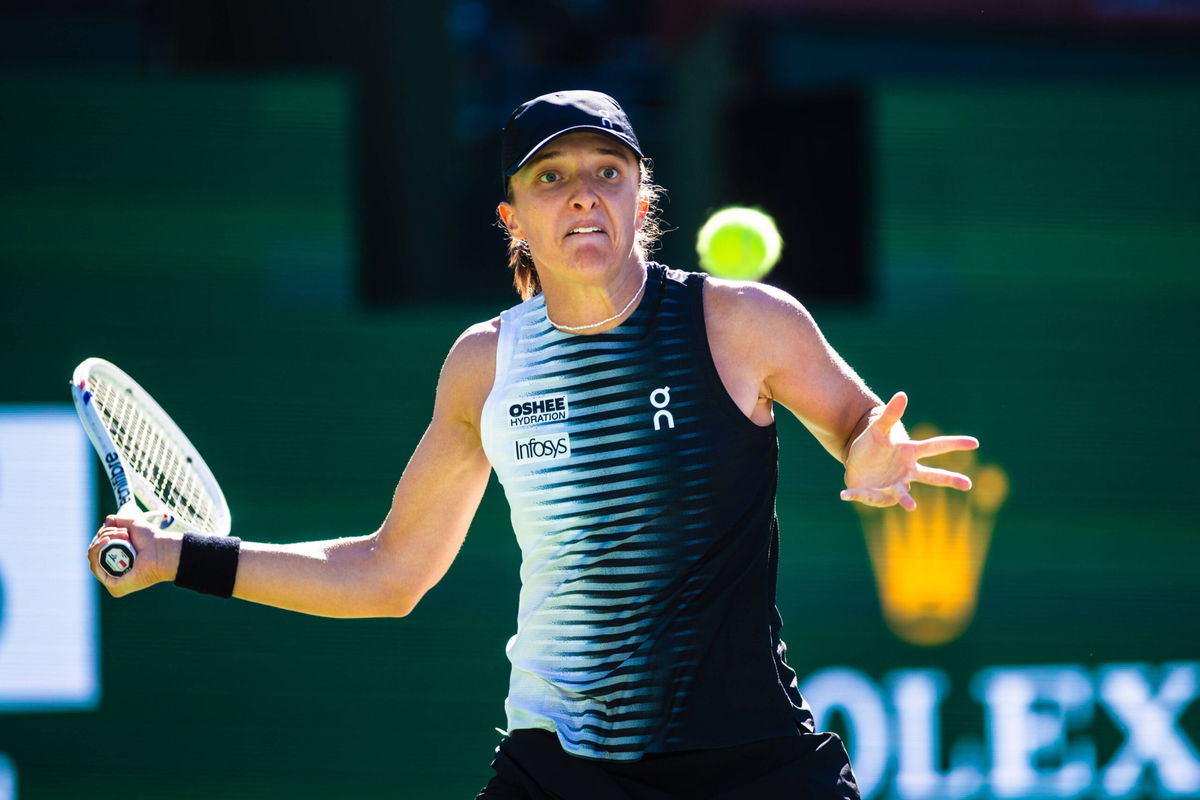
Tennis 2026: BNP Paribas Open, March 7, 2026 March 7, 2026: Iga Swiatek POL in action against Kayla Day USA during their round 2 match at the BNP Paribas Open on March 7, 2026, held at the Indian Wells Tennis Garden in Indian Wells, California. Credit Image: Mal Taam/Cal Media Indian Wells California USA EDITORIAL USE ONLY Copyright: xx ZUMA-20260307_zma_c04_432.jpg MalxTaamx csmphotothree478206
Imago
Tennis 2026: BNP Paribas Open, March 7, 2026 March 7, 2026: Iga Swiatek POL in action against Kayla Day USA during their round 2 match at the BNP Paribas Open on March 7, 2026, held at the Indian Wells Tennis Garden in Indian Wells, California. Credit Image: Mal Taam/Cal Media Indian Wells California USA EDITORIAL USE ONLY Copyright: xx ZUMA-20260307_zma_c04_432.jpg MalxTaamx csmphotothree478206
Just a month ago, Iga Swiatek was going through what felt like her ‘worst nightmare’: early exits, shaky form, and growing self-doubt. At the Hard Rock Stadium during the Miami Open, her second-round loss to Magda Linette seemed to be the tipping point. Soon after, she decided to part ways with her coach, Wim Fissette.
Watch What’s Trending Now!
At a crossroads, Swiatek turned to Rafael Nadal’s former coach, Francisco Roig, and headed to the Rafa Nadal Academy in Mallorca to reset and rebuild.
After putting in the work and slowly regaining her confidence over the past few weeks, she’s now arrived at Stuttgart Open looking for a fresh start. And going by her intensity in practice, it feels like she’s ready to make a strong statement again, especially on clay, a surface where she’s always looked most at home.
Top Stories





A practice video filmed on center court at the Porsche Tennis Grand Prix in Stuttgart shows Iga Swiatek and Paula Badosa practicing. The pole looked sharp and deliberate in the shape ahead of her first tournament. What really stands out in the clip is her serve. The six-time Grand Slam champion is striking aces with both power and precision, something that’s bound to catch attention, especially given how much her serve has been under the spotlight during a challenging 2026 season.
Iga Świątek in her ACEtek era ✨
Poprosimy o takie serie w meczu 🙏
🎬 Porsche Tennis | YT | #PorscheTennis | #zkortu pic.twitter.com/KhTthRDQUv
— Z kortu – informacje tenisowe (@z_kortu) April 12, 2026
Speaking after her Quarterfinal exit at the Australian Open against Elena Rybakina, Swiatek herself admitted to the inconsistency in her serving and was candid about trying to fix it.
“This year, we didn’t manage to completely close the stuff that we wanted to change in the pre-season, so this year I felt like I also needed to work on it during the tournament, and that’s why maybe I felt like I played a tiny bit worse,” she said.
Roig is now the architect of that process, who is generally considered to be among the best technical brains in the sport. The coaching philosophy of the Spaniard indicates that the concept of serving better and the introduction of variety to the game are the main aspects of his approach, which is precisely what Swiatek has been attempting to implement herself.
The two started their collaboration at the Rafa Nadal Academy in Mallorca, where Nadal himself entered the practice court to impart his knowledge to Swiatek. The visuals attracted considerable attention and garenred positive reactions in coaches and critics observing it remotely.
Former WTA professional Coco Vandeweghe did not mince her words when analyzing Swiatek’s issues during a recent Tennis Channel discussion.
“He’ll bring consistency,” she said of Roig’s appointment. “And I noticed in a couple of the films that Iga looks like she has kind of tinkered with her serve a little bit. Her arm looks a little bit looser and I think that’s where the biggest problem was coming in Iga Swiatek’s game. She wasn’t able to make enough first serves or get the direction moving on her first serve, and that’s why Sabalenka was able to dominate or Rybakina in these rallies, or any of those big hitters.”
Iga Swiatek, who came to Stuttgart is in a different form. The serve is there. The purpose is discernible. And the surface is the one upon which she has dominated for years, a four-time Roland Garros champion is back on the red clay where her finest tennis has always been.
Swiatek is a third seed with a bye in the first round in Stuttgart. Her possible route is challenging. She could face former champion Laura Siegemund or compatriot Magdalena Frech in the second round.
In case she advances, she might face defending champion Jelena Ostapenko in the quarterfinals, whom Swiatek has lost each of their six career encounters, including their most recent encounter in Stuttgart quarterfinals last year. The world No. 2 Elena Rybakina also featured in the top half of the draw after Aryna Sabalenka’s pre-tournament withdrawal.
Why the split with Wim Fissette was inevitable
The coaching change was not unexpected. Iga Swiatek had been preparing for it for months and was precise in her argument when she spoke in public.
“It’s not something someone like me decides right after a failure. I wouldn’t make such a decision lightly. I don’t make impulsive decisions, I’m quite rational.”
She further added, “I don’t make many changes within the team; I like to give the team the opportunity to ‘reset’ and start working in a slightly different way. However, in this case, I felt it was just time for a change. Yes, it wasn’t a decision made in Miami but rather a longer process during which I carefully considered everything.”
The frustration had been building up since Doha. Following her quarterfinal defeat to Maria Sakkari, Swiatek and her camp huddled and attempted to devise a solution, and some progress was made before Indian Wells. When the Miami departure led the team to the ultimate reckoning, a final decision was taken by the Polish star.
Roig comes with a philosophy that has been constructed on the basis of clay, the surface that played a vital role in Nadal’s 14 Roland Garros titles. It is the same surface on which Swiatek has built her legacy. Their convergence, on paper, is as strong as it gets. Their initial trial is at hand, and Stuttgart becomes the vantage point of their journey.
Written by

Edited by

Purva Jain