Imago
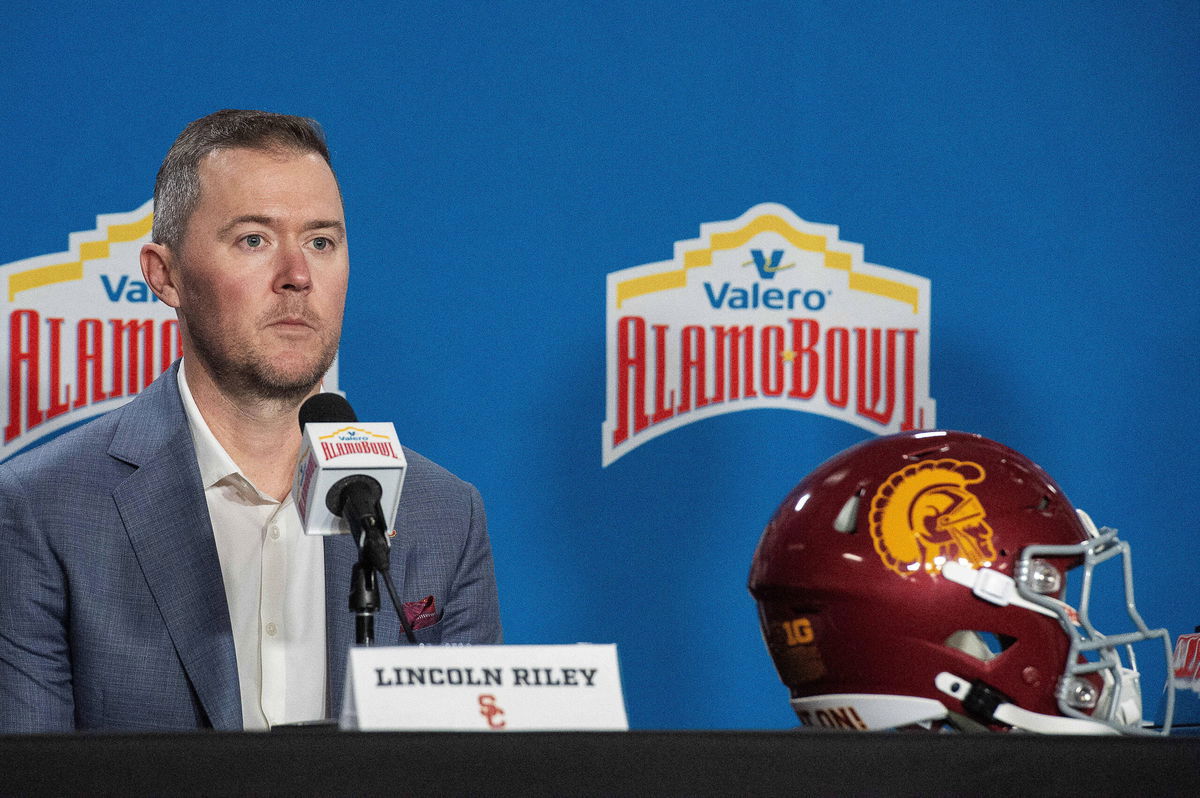
December 29, 2025: USC Trojans Head Coach Lincoln Riley with TCU Horned Frogs Head Coach Sonny Dykes hold a joint press conference, PK, Pressekonferenz at the Alamodome prior to the NCAA, College League, USA Valero Alamo Bowl. San Antonio, Texas. /CSM San Antonio United States of America – ZUMAc04_ 20251229_faf_c04_010 Copyright: xMarioxCantux
Imago
December 29, 2025: USC Trojans Head Coach Lincoln Riley with TCU Horned Frogs Head Coach Sonny Dykes hold a joint press conference, PK, Pressekonferenz at the Alamodome prior to the NCAA, College League, USA Valero Alamo Bowl. San Antonio, Texas. /CSM San Antonio United States of America – ZUMAc04_ 20251229_faf_c04_010 Copyright: xMarioxCantux
USC Trojans head coach Lincoln Riley offered his perspective on NIL, highlighting how the balance of power in football is changing. As Riley feels that the NIL era is the ultimate turning point in the sport, David Pollack could not agree with Riley’s viewpoint. He reposted the head coach’s interview with a blunt remark.


“I think the parity,” Riley said on The Herd podcast, talking about what he likes about the NIL structure. “Now there’s not just one part of the country paying players. Everybody’s able to do it… It’s allowed schools to really compete if they wanna invest, and I think it’s been a great thing for players.
Watch What’s Trending Now!
“This is absolutely laughable,” Pollack, who’s in the College Football Hall of Fame as part of the Class of 2020, did not mince his words in the caption while re-sharing Riley’s interview.
Pollack disagreed because the practical outcome has been far from fair competition. Schools with deeper donor bases, larger fan followings, and stronger brand power have far more resources to push harder with NIL collectives.
Texas Tech didn’t shy away from spending big in the NIL era, investing close to $30 million to build its roster, per CBS Sports. The heavy investment paid off in a big way, as the Red Raiders rolled to 12 wins, captured the Big 12 title, and secured a first-round bye in the College Football Playoff.
This is absolutely laughable. https://t.co/YBQONKxSQI
— David Pollack (@davidpollack47) February 3, 2026
This financial arms race is a stark contrast to the pre-NIL era, where elite players were often drawn to programs for reasons beyond money, such as development and opportunity
While Riley focuses on the parity that NIL brought, in the modern college football economy, that’s what a heavy investment looks like when it actually works. Secondly, before the NIL ruling in 2021, elite players often prioritized development and opportunity over financial incentives.
Carson Wentz led North Dakota State to multiple national titles and turned an FCS program into a national brand. Hailing from a program with little national hype, he became the No. 2 overall pick in the 2016 NFL Draft.
For critics, Riley’s praise of the current system is particularly tone-deaf given USC’s own history, which includes the infamous Reggie Bush scandal; a situation that highlighted the NCAA’s hypocrisy in profiting from a player’s likeness long before NIL was legalized. Bush was a generational talent who redefined college football over three seasons at USC. He filed a lawsuit in 2024 and accused USC, Pac-12, and the NCAA of profiting off his NIL without compensation.
That reality is central to why Riley’s comments feel disconnected from critics. Smaller programs thrived under that model because they focused on retaining talent and developing players. However, the NIL structure has flipped, with programs that offer the biggest checks now luring away already-developed players.
Riley’s view of a level playing field is further challenged by the aggressive tactics seen across the country, with programs like LSU recently drawing scrutiny for pushing the boundaries of NIL.
The cracks in Lincoln Riley’s NIL case became hard to ignore
LSU Tigers have become aggressive in NIL, drawing scrutiny from the College Sports Commission. The program faced controversy with Demond Williams’ buzz and a $3.5 million offer involving Cincinnati transfer Brendan Sorsby, suggesting they were pushing NIL limits.
This came months after the House v. NCAA settlement set a new financial ceiling in college sports. It allowed schools to distribute up to $20.5 million directly to athletes in 2025–26. That figure is expected to rise annually at about 4%, pushing the cap close to $33 million by 2034–35.
While this seems like a step toward parity, it fails to address the core issue Riley overlooks: the unlimited potential for third-party deals that keeps the wealthiest programs on top.
And that’s the fundamental flaw of Lincoln Riley’s belief that NIL leveled the playing field.
Written by

Edited by

Jacob Gijy