
Imago
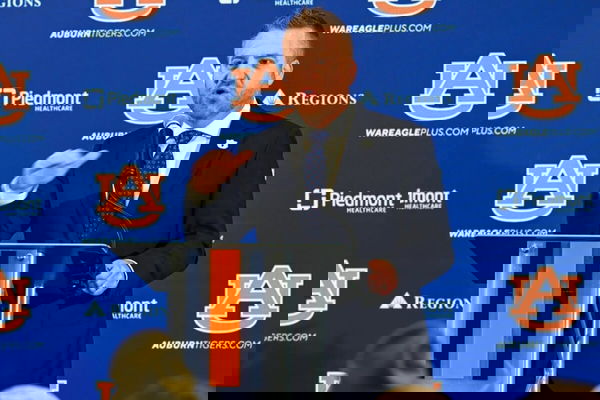
NCAA, College League, USA Basketball: N.C. State at Auburn Dec 3, 2025 Auburn, Alabama, USA Auburn Tigers head football coach Alex Golesh is introduced during the first half of a basketball game between the Auburn Tigers and NC State Wolfpack at Neville Arena. Auburn Neville Arena Alabama USA, EDITORIAL USE ONLY PUBLICATIONxINxGERxSUIxAUTxONLY Copyright: xJohnxReedx 20251203_jhp_sr5_0398
Imago
NCAA, College League, USA Basketball: N.C. State at Auburn Dec 3, 2025 Auburn, Alabama, USA Auburn Tigers head football coach Alex Golesh is introduced during the first half of a basketball game between the Auburn Tigers and NC State Wolfpack at Neville Arena. Auburn Neville Arena Alabama USA, EDITORIAL USE ONLY PUBLICATIONxINxGERxSUIxAUTxONLY Copyright: xJohnxReedx 20251203_jhp_sr5_0398
Alex Golesh’s 2026 blueprint for Auburn is already taking shape, and it starts by attacking the biggest weakness of the Hugh Freeze era. Leading the list is the emphasis on the run game, which must improve for the Tigers to have a promising season.


“You had a guy in Jeremiah [Cobb] who had a phenomenal year a year ago, said Golesh during the NSD press conference. It’s a spot you’ve got to have multiple guys that can do it. We’re going to run the heck out of the ball. We’ve done it for as long as I’ve been a head coach and coordinator.
Watch What’s Trending Now!
That’s where it all starts offensively for us is you’ve got to be able to run the football, and I don’t care what league you’re in. You need backs that can run the ball.”
For starters, running back Jeremiah Cobb genuinely shone by leading the team with an impressive 969 rushing yards. Auburn, averaging 176.8 yards per game, ranks 77th nationally. Golesh, who brings a wealth of coaching experience, including head coaching at South Florida and running backs coaching at Toledo, believes in maintaining a steady running game as a fundamental part of his offensive strategy. He wants to rely on it rather than use it only in specific situations or against certain opponents.
To him, it sets the physical tone, controls the pace of the game, and forces defenses to react. According to Golesh, this principle applies irrespective of the league. Golesh feels more strongly about the importance of the running game after the 2025 loss against Texas A&M. The Aggies crushed the Tigers 16-10, marking the second SEC loss. The big reason behind the fall was that their running backs failed to reach 15 combined carries.
“We probably need to be calling some more runs,” Freeze admitted. “I would love to have the possession, right before the last one we had, back. We had plenty of time to run the ball there, too.”
Among the challenges faced by the 2025 Tigers, the most costly was their failure to develop a reliable ground attack, which directly resulted in crucial losses.
Let’s relive that exciting game! Auburn had two last-minute chances but missed both. They pushed hard when down 16–10 with 2:41 left, but faced tough luck with three incomplete passes and punted to Texas A&M. Their final drive was quick; Jackson Arnold connected twice, then on third-and-one, Auburn chose to pass again, resulting in an incomplete pass and sack. The ball went back to the Aggies, ending their comeback effort.
Adding to the woes, the running backs were held out of the end zone in the first quarter. Cobb logged six carries, Damari Alston just two, for a shockingly low eight total. Running back struggles have defined the 2025 college football season. Jam Miller, Daniel Hill, and company managed only 3.5 yards per touch, the Alabama Crimson Tide’s worst output in three decades.
That logic clarifies why their transfer portal haul has skewed heavily toward running backs.
Alex Golesh and his offensive coordinator align on a run-first blueprint
Like Golesh, his offensive coordinator, Joel Gordon, shares the same philosophy on bolstering the run game.
“You’ve got to have depth at that position, regardless of what offense you play in,” the coach said about stacking their 2026 class with transfer running backs. “There’s got to be guys that are ready to be fresh. That’s where our offense starts is running the rock and being physical.”
With three years under his belt, Cobb stood as the veteran of the room, while Henderson and Mabson II finished 2025 as freshmen. Golesh had addressed the gap by adding Baylor transfer Bryson Washington, Nykahi Davenport from USF, and Tae Meadows from Troy. All of them are experienced players, already surpassing the Tigers’ young backs behind Cobb in collegiate carries.
Among Golesh’s running back recruits, Washington stands out as arguably the most significant addition. He averaged 5.9 yards per carry, which is the third-best among Baylor’s freshmen historically. This overhaul could be just what Alex Golesh needs to finally resolve Auburn’s running back issues.
Written by

Edited by

Jacob Gijy