More on TRACK AND FIELD
“It’s Life-Decimating”: Olympian Bed-Ridden for 22 Hours a Day With Rare Disease Diagnosis
The 32-year-old former sprinter who once took part in the Olympics shares her heartbreaking story about living with a rare disease.

Olympic Champion Shares Heartwarming Life Update After Long Absence From the Track
Athing Mu announces her pregnancy after a long absence from racing, raising questions about her return and hopes for the LA28 Olympics.
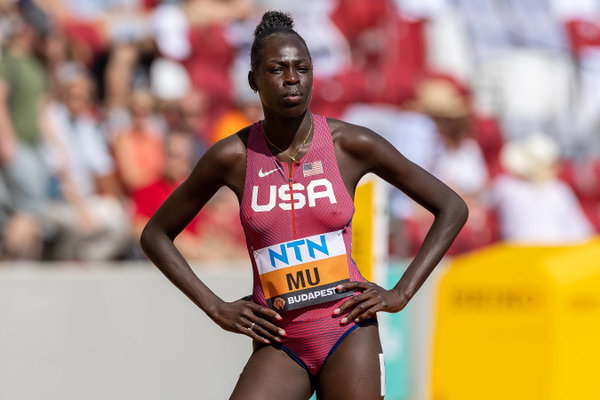
Agent Confirms Track and Field Star Suffered Skull Fracture After Car Crash
The 25-year-old American track and field star's agent confirms a terrible on-road accident, which resulted in a fractured skull.
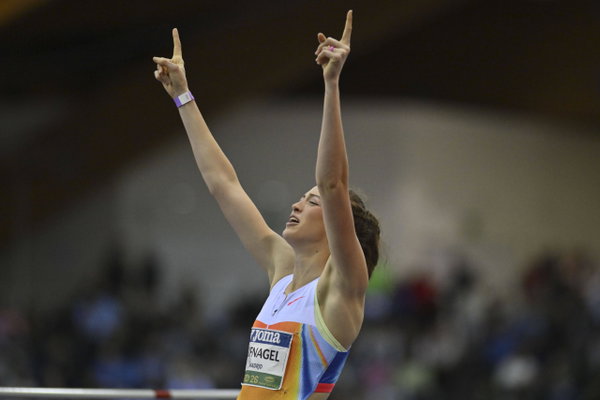
Ezra Frech’s 9-Year-Old Ellen Show Video Goes Viral After Dancing With the Stars Stint
The 21-year-old American track and field star's iconic moments resurface on social media as a fellow Paralympian showcases her support.
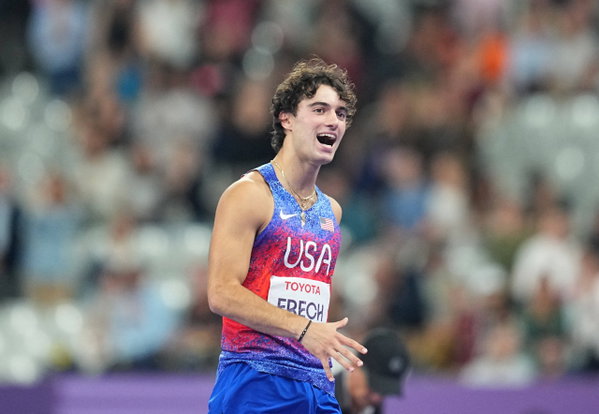
US Runner Faces Nightmare Ahead of New York Race as Injury Turns Into Full-Blown Tear
The 28-year-old American long-distance runner's 2026 New York Marathon participation is some serious doubts after surgery.

Plans for Statue of Track and Field Legend Responsible for Many Olympic Champs in Motion
Plans advance for statue honouring Stephen Francis, the legendary coach behind multiple Olympic champions and Jamaica’s sprinting success
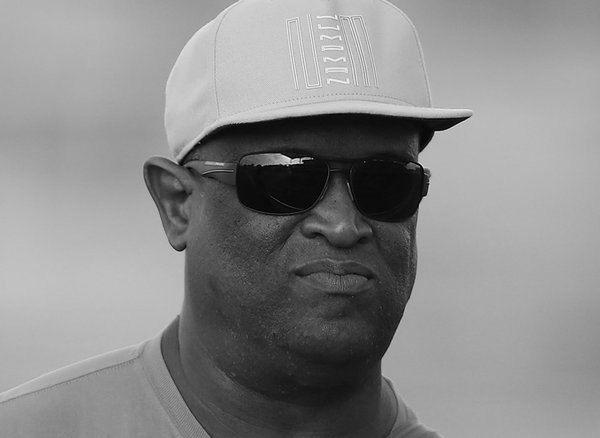
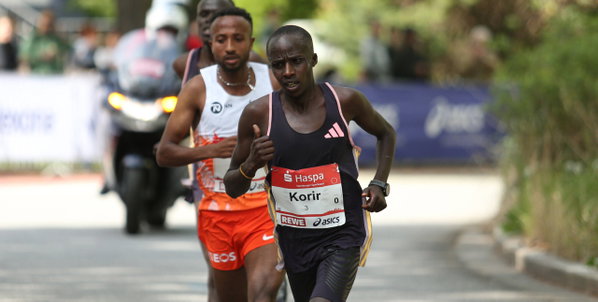
4th-Place Finish Kenyan Runner Faces Doping Suspension Following Prohibited Substance Check
Kenyan marathoner faces provisional suspension in an AIU anti-doping case involving his Athlete Biological Passport.
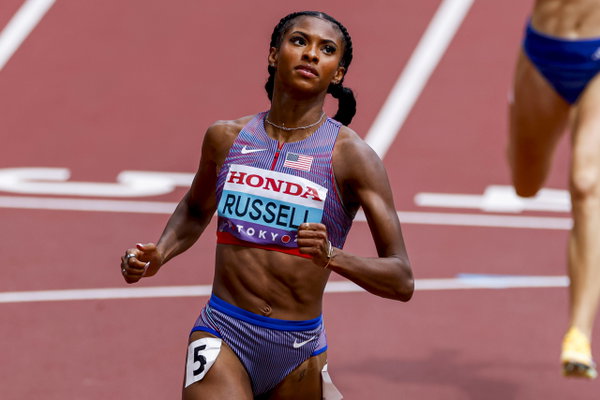
Masai Russell’s Rival Reveals Ignoring Achilles Injury Warning Signs Before Devastating Setback
Masai Russell’s rival opens up about the Achilles injury that ended her season, revealing the warning signs she ignored before the race.
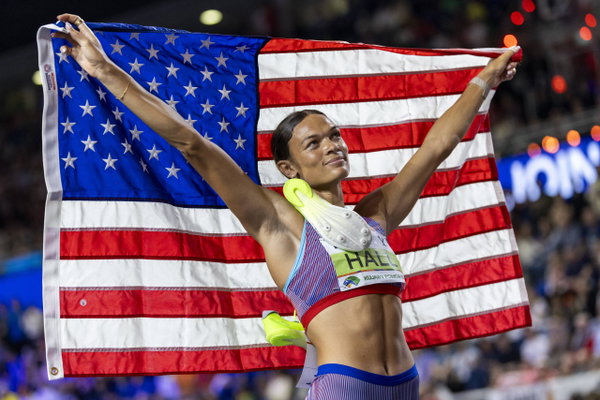
US World Champion Rallies Sister Who Completed Chicago Race Just 13 Weeks After Giving Birth
Anna Hall celebrates sister Julia’s inspiring Chicago Marathon finish just 13 weeks after giving birth to her second daughter
“Women’s Sports is Not Charity”: Athlos CEO Alexis Ohanian Makes Bold Statement on the Future
Alexis Ohanian outlines his vision for the future of women’s sports and explains why he believes the business potential remains untapped

Chicago Race Under Fire for Snubbing Commentary in Favor of Interviews Mid-Race
The Chicago Marathon 2026 gets heavily criticized for poor broadcast as fans get deprived of some exciting moments during the race.
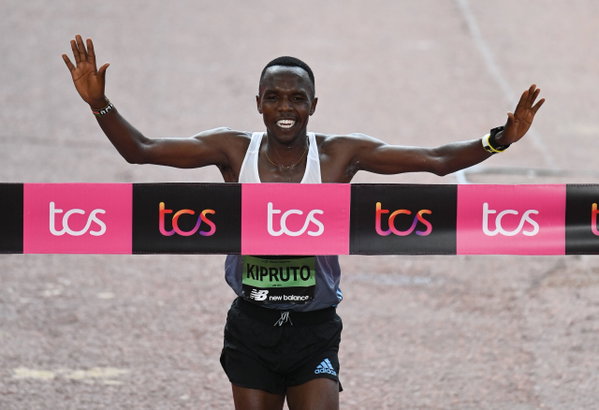
2-Time Olympic Champion Ends Three Year No-Win Drought Posting Meet Record
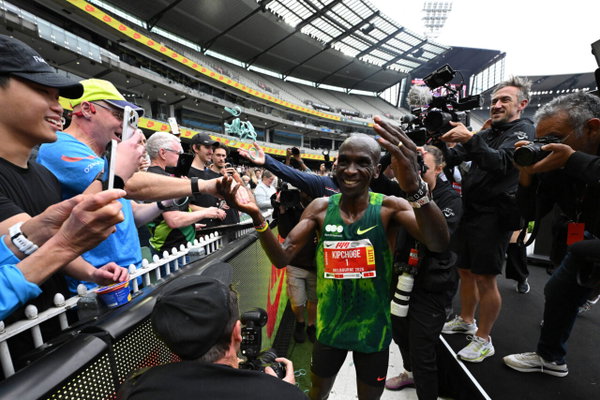
Two-time Olympic champion ends his three-year winless streak with a course-record 2:09:10 victory at the Melbourne Marathon.
About TRACK AND FIELD
Track and Field: History and evolution of the sport
On the marks, set, go. If only the evolution of track and field were so easy. Instead, it was something that gradually happened over years of evolution.

Ancient- One of the oldest sports to have existed, the cornerstone of track and field was laid by the Greeks, where men would exhibit their athletic talents as part of celebratory events. Initially limited to foot races, stadion and diaulos were the competitions that comprised the crux of the sport, which has been around since the first Olympics in Ancient Greece, dating back to 776 B.C. Although the Romans continued the games till 394 A.D., when it was banned, the sport saw a resurgence after the decline of the Roman empire. Tracing back to the 16th and 17th centuries, foot races had become a regular sight in Europe.
Modern- The 1860s predominantly saw the wave of transformation, wherein the first championships featuring amateur men were held in England. Athletic clubs and organizations sprung up across Europe and the United States, with the Amateur Athletic Union (AAU) coming into being in 1887.
Olympic age- 1896, was when the first Modern Olympic Games were flagged off in Athens, which included track and field in the sports that debuted.
20th century- With athletes flocking from across the world to exhibit their athletic talent, track and field's stature elevated substantially. Technical developments fostered improvements in training and diet, and the track saw the likes of legends like Jesse Owens, Usain Bolt, Flo-Jo, etc coming out at the top.
What are the major events in track and field?
Track and field is a sport that covers a plethora of events under its banner. Speaking of the Olympics in particular, it features 48 events, 24 men's events and 24 women's. Care to know what they are?
| Track Discipline | Events |
| Sprint | 100m, 200m, 400m |
| Middle-distance/Long-distance | 800m, 1500m, 5000m, 10000m, 3000m steeplechase |
| Hurdles | 100m hurdles, 110m hurdles, 400m hurdles |
| Road Running | Half marathon, marathon |
| Race Walks | 20k race walk, 35k race walk |
| Relays | 4x100 relay, 4x400 relay, 4x400 relay mixed |
| Field Discipline | Events |
| Jumps | High jump, pole vault, long jump, triple jump |
| Throws | Shot put, discus throw, hammer throw, javelin throw |
| Combined Events | Heptathlon, Decathlon |
| Cross Country | |
| Mountain Running | |
| Ultra Running | |
| Trail Running |

What are the rules and regulations of track and field in major competitions like the Olympics?
Sprinting Rules
- Most of the sprinting events from 100m to 5000m conduct qualifying rounds before the finals. Usually heats, semifinals, and then the finals. The top three on the finals scoreboard take home gold, silver, and bronze.
- Sprints, hurdles, and relay races feature starting blocks, followed by the firing of a pistol to commence the race. If a runner starts before the fire, it's called a 'false start.' This will lead to disqualification.
- 100m sprints and 110m/100m hurdles comprise starts where racers are all in one line. Whereas, in the 200m, 400m, 400m hurdles, 4x100m relay, and 400m relay categories, they are placed in staggered positions.
- Running outside the allocated lanes would also lead to disqualification. If an athlete is forced to cross the lane by another one so that there is no material advantage, they will not be disqualified. The same for a person who strays out or crosses the line, and in doing so, they do not get an advantage, there will be no disqualification.
- The athlete whose torso crosses the vertical finish line plane will be declared the winner.
- For any of the relays, baton handover must not happen beyond the 20m changeover box. If yes, then this would amount to disqualification.
- The baton should not fall or touch the ground in any way.
- There are no starting blocks in these races. Also, athletes line up in an upright position. In 800m, the 8 runners will stand in staggered positions before the start. Through the first turn, they have to stay in their respective lanes, but can then break to the inside. If done very early, then can lead to disqualification.
- 1500m and the steeplechase have group starts, and no fixed lanes are allocated.
- In steeplechase, if an athlete steps aside during a barrier, they will be disqualified. They can jump above them in any way, but no part of the foot or leg should be below the horizontal plane of the upper bar while they are attempting to clear it.
- The 10,000m, marathon, race walk, decathlon, and heptathlon are events that directly conduct finals with no qualifying rounds.
- The starts happen in an upright position and involve no touching of the ground.
- Usually, these feature mass starts. However given the possibility that there are more than 12 runners in the race, they are divided into staggered groups. The first one will have 65 percent of the athletes that usually appear on a start line.
- There are no lane assignments. Track athletes can break for positions right after the commencement.
- The walker must be in contact with the ground continuously. Even the advancing leg should be straight from the instance when it comes in contact with the ground till it goes into the upright position.
- There are anything between six and nine judges in the event. And they are free to issue warnings upon violations like leg contact or perhaps a bent knee.
- If participating athletes get warnings from 3 different judges, they get disqualified. Also, if an official medical officer asks them to retire from the race, the competitors must leave.
- High jump- The jump-off must happen from one foot. And given that the athlete makes contact with the crossbar and falls off the supports, it will be counted as a failed attempt. Also, athletes will be given 3 attempts for a particular height. The option to pass a certain height and try for the next is also available. But, if there are 2 failed attempts at a single height, and the athlete skips that to move on to the next, the next should be cleared on the first try.
- Pole Vault- Participants can use a substance either on their hands or the pole to facilitate a better grip. But, tape on fingers or hands is prohibited, unless there is an open wound. Athletes are also allowed to use their poles, of any material, length, or diameter. If they break, the participants still get another go at it. However, there are three criteria for disqualification. First is when the vaulter makes the crossbar fall by touch. Second is when they move their lower hand above their upper one or their upper hand higher on the pole after leaving the ground. And third, if they steady or replace the bar while conducting the vault.
- Long Jump- The measurement for the jumps is calculated from the takeoff line to the closest break in the landing area, done by any part of the participant's body. Failed attempts happen on exceeding the takeoff line while jumping, or on taking off from outside either end of the take-off board. Or perhaps touching the ground outside the landing area closer to the take-off line, in comparison to the nearest break in the sand.
- Triple Jump- There are three stages of a triple jump- a hop, a step, and a jump, all done in the said sequence. Hope and jump have to be made from the same foot used for take-off, while the step involves the other. Failed attempts have identical criteria to the long jump. However, there is one exception, and that is when an athlete makes contact with the ground with their sleeping leg during a jump, it isn't considered a failure.
- The decathlon and heptathlon events are conducted over two consecutive days.
- In both these events, 3 attempts in the long jump, shot put, discus, and javelin throw are allowed. And a single false start in track events is allowed.
- Shot, discuss, and hammer throw are all done from within the demarcated throwing circles. While the javelin throw features a runway. Crossing either while a throwing attempt is made will count as a failed attempt.
- Also, the athletes must not exit and stay in the throwing area until the javelin or the respective implement touches the ground. And for it to be considered a valid throw, they should land within the landing zone.
- Gloves are only permitted in hammer throw, while any sort of tape is not allowed unless there is an open wound on the hands or the fingers.
Getty
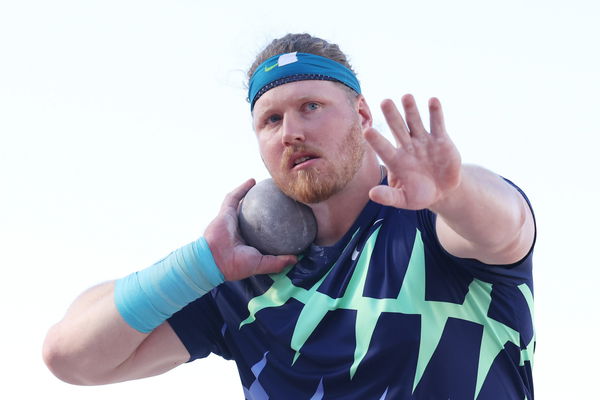
EUGENE, OREGON - JUNE 18: Ryan Crouser competes in the Men's Shot Put final during day one of the 2020 U.S. Olympic Track & Field Team Trials at Hayward Field on June 18, 2021 in Eugene, Oregon. (Photo by Andy Lyons/Getty Images)
What are the major track and field championships?
Some of the pivotal athletic competitions include-
- The Athletics World Championships (Once every 2 years)
- Olympic Games (Once every 4 years)
- Commonwealth Games (Once every 4 years)
- World Indoor Championships (Once every 2 years)
- World Diamond League Meetings (Every year)
- World Athletics Relays (Biennial)
- Marathon Majors (Every year)
- World Athletics Cross Country Championships (Biennial)
- New York Marathon (Every year)
Who are the greatest track and field stars of all time?
Here are some of the most decorated track and field athletes of all time:
| Name | Country | Event | Olympic medals | Personal best |
| Paavo Nurmi | Finland | Middle and Long Distance Runner | 12 medals- 9G, 3S | 10000m - 30:06.2h 3000m - 8:20.4h 5000m- 14:28.2h |
| Carl Lewis | United States
| 100m,200m, Long Jump, 4x100m relay | 10 medals- 9G, 1S | Long Jump- 8.87 100m- 9.86 200m- 19.75 |
| Usain Bolt | Jamaica | 100m, 200m, 4x100m relay | 8 medals- 8G | 100m- 9.58 (WR, AR) 200m- 19.19 (WR, AR) |
| Jesse Owens | United States | 100m, 200m, Long Jump, 4x100m relay | 4 medals- 4G | 100m- 10.2h 200m- 20.7h 4x100m relay- 39.8h Long Jump- 8.13 |
| Allyson Felix | United States | 200m, 4x400m relay, 4x100m relay, 400m | 11 medals- 7G, 3S, 1B | 200m- 21.69 400m- 49.26 4x100m relay- 40.82 4x400m relay- 31.16.85 |
| Florence Griffith Joyner | United States | 100m, 200, 4x100m relay, 4x400m relay | 5 medals- 3G, 2S | 100m- 10.49 200m- 21.34 |
Getty
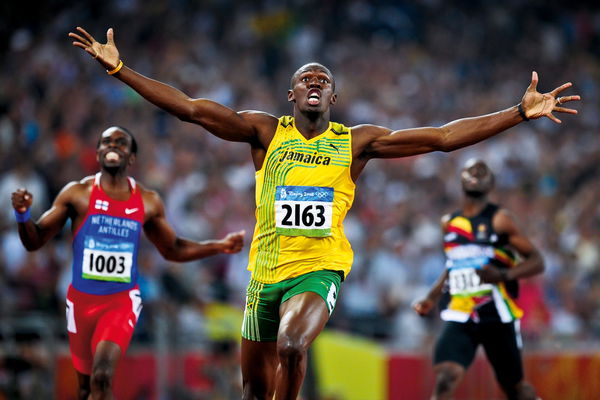
Usain Bolt of Jamaica reacts as he wins the Olympic mens 200m final in a new world record time in the Birds Nest stadium, Beijing on August 20th 2008 in Beijing, China (Photo by Tom Jenkins/Getty Images). An image from the book "In The Moment" published June 2012
| Jackie Joyner-Kersee | United States | Heptathlon, Long Jump | 6 medals- 3G, 1S, 2B | Heptathlon- 1331 Long Jump- 7.49 |
| Bob Beamon | United States | Long Jump | 1 medal- 1G | Long Jump- 8.90 |
| Javie Sotomayor | Cuba | High Jump | 2 medals- 1G, 1S | High Jump- 2.45 (WR) |
| Jan Zelezny | Czechia | Javelin Throw | 4 medals- 3G, 1S | Javelin Throw- 98.48 (WR) |
| Haile Gebrselassie | Ethiopia | Long Distance Runner | 2 medals- 2G | 10000m- 26:22.75 5000m- 12:39.36 |
| AI Oerter | United States | Discus Throw | 4 medals- 4G | Discus Throw- 69.46 |
| Sergey Bubka | Ukraine | Pole Vault | 1 medal- 1G | Pole Vault- 6.15 |